Most Multi-Location Brands Get Local Social Ads Wrong – Here's How to Fix It
Most multi-location brands run social ads the wrong way: awareness campaigns, no conversion tracking, and generic creative across every location. Social ads expert Sarah Sal breaks down what to do instead — with a real case study that turned an 8.27× ROAS from a strategy built on storytelling, hyperlocal targeting, and the right campaign objectives.


Imagine spending $100,000 on Meta ads and having no idea if it generated any sales.
The Barbershop A Hair Salon for Men is a multi-location business that wanted to use Meta ads to promote eight of its locations. While they knew how many impressions and clicks the ads generated, they had no idea what their ROI was.
They hired an agency that spent $100,000 and had no idea if those ads generated any sales. That is when the hair salon chain reached out to me and asked if I could coach their employees on how to run the ads in-house.
Fast-forward to today: They spent $11,421.75 on ads and generated $94,466.67 in sales, achieving an 8.27× ROAS.
In this post, I'll mention the exact steps I used to help them start generating sales at a high ROI — and give teams managing multiple locations inspiration on how to really leverage social ads.
The Difference between Local Brand Awareness and Performance Marketing
This section is for you if you've never run social ads, or you're running them and seeing no results across your locations.
The story below highlights how people who have never advertised think about ads.
A friend once told me, "My sister wants to run ads to promote her pen brand for lefties."
I asked, "What is she hoping to get from the ads?"
She said, "I guess … getting the word out."
I asked, "Only that? Does she want traffic, too?"
"Probably."
Then I asked, "If the ads get views and traffic but no sales, would she be happy?"
People assume that if people simply see the ads, they will buy. But in reality, you are interrupting strangers, and you need to persuade them to convert.
In the case of The Barbershop, the agency spent $100,000 on awareness ads.
When asked how the ads performed, they produced graphs and reports showing that millions of people saw the ads.
But when asked how many sales those views generated, they couldn't answer.
That's the difference between brand awareness and performance marketing.
Brand awareness focuses on visibility, not immediate sales.
If you're a large international brand like Starbucks, this might work. You're everywhere: in airports, train stations, shopping centers. Someone might see your ad, do nothing, and still remember you later.
But for smaller, lesser-known brands with numerous local competitors, it's different. If someone sees your ad and doesn't take action, you've likely lost them.
That's why performance marketing focuses on driving immediate, measurable sales.
Never Run Ads Without Conversion Tracking in Place
This cannot be said enough. If you run Meta ads specifically, you need to have Meta conversion tracking in place.
Not only does it let you see whether your ads are working, but it also shows which ads are delivering the highest ROI.
Not only do I want to track the final conversion, which is the purchase; I also want to track every step of the funnel.
For example, tracking allows me to see if many people selected a date to get a haircut but did not confirm it. I want to know where people drop.

Of course, I believe in having multiple sources of truth when it comes to sales.
So I asked a hairdresser at The Barbershop if she was busier than usual, and she said, "I am busier, but also many other hairdressers told me they are busier than usual."
Not only that: I was told that in December, they sold the most gift cards ever.
Furthermore, for a multi-location brand, Meta tracking helps answer important questions such as:
- Which locations are converting better?
- Which offers work best, and where?
For example, one barbershop location might see strong demand for kids' haircuts, while another gets better results with a hair-coloring offer.
This is where platforms that centralize social performance across all your locations — or dedicated social ads experts — can really tell you where to optimize your efforts.
Maximize your chances of success by running conversion campaigns
When you create a campaign on Meta, Meta asks which objective you want to use.
That choice tells the algorithm what to optimize for.
If you want leads or sales, select "Leads" or "Sales." If you don't, you're training the system to pursue the wrong outcome.
Anything else is like going to a restaurant, ordering a pizza, and wondering why the waiter didn't bring you a salad.
The algorithm follows instructions. Make sure you give it the right ones.
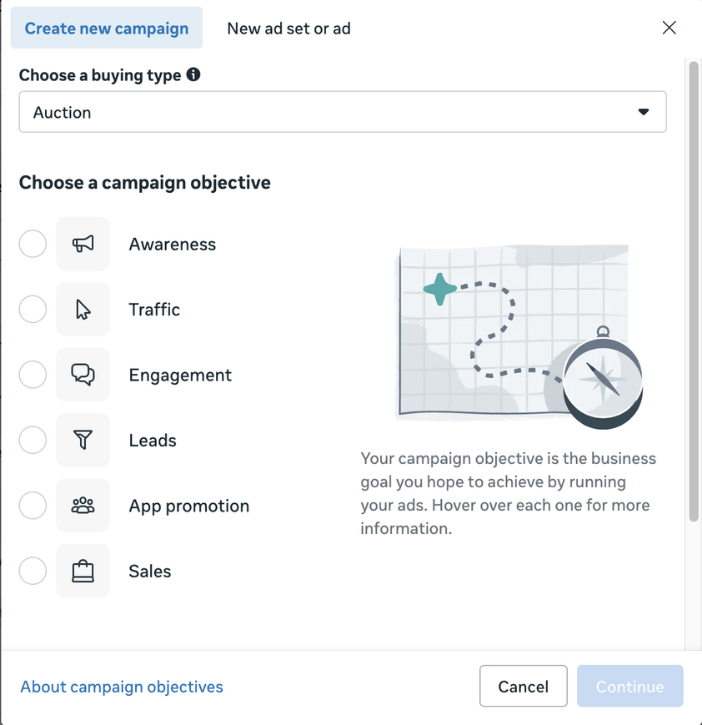
Campaigns with the "Leads" or "Sales" objective are called conversion campaigns.
Another reason to run a conversion campaign is that it helps Meta's algorithm focus your budget on users who are most likely to take action — and filter out low-quality traffic.
Like any major platform, Meta has its share of inactive accounts and low-intent users.
When you run ads with the wrong objective like awareness, the algorithm optimizes for reach, which means your budget can end up being spent on people who were never going to convert.
I've tested this. Same ad. Same targeting. Switched from a conversion campaign to an awareness campaign, and I watched clicks drop by 10 to 20×.
What's worse? The second I changed a conversion campaign to another objective, conversions tanked. Sales? Gone. Leads? Vanished.
That's because conversion campaigns tell the algorithm exactly who to find — people ready to take action. Without that signal, your budget works a lot less efficiently.
Next I will talk about ad creatives and how to use storytelling to capture attention and drive sales.
Why You Don't Need Discounts to Drive Sales
For years, many businesses have complained that they need to offer discounts on their social channels to get sales.
And on top of giving a discount, they also pay for ads.
I'm not saying a discount isn't sometimes worth it, like during low season or happy hours. But it doesn't have to be your only strategy.
That is because many ads simply state what they sell, meaning the ad reads something like this: "Want a haircut? I give haircuts."
Instead, educate the person reading the ad. Show them which styles suit frizzy hair versus those that suit smooth hair. Position yourself as an expert or become a commodity fighting on pricing.
Many local marketing teams think ads are about finding someone who needs a haircut, but the ads need to persuade a stranger why they are better than the local competition.
Back to my previous example, when talking to the CEO of The Barbershop, I found that Wisconsin was rolling back regulations regarding health and safety related to the sterilization of equipment.
So I helped them craft the hyperlocal ad below, which says that The Barbershop will never cut corners when it comes to health and safety, which is a good way to stand out and tell customers why they are different.

Run Meta ads that target the exact hyperlocal areas around each of your store locations, and pair them with ads that position you as the expert. That's how you turn attention into real sales.
Storytelling Is the Highest Form of Persuasion
According to Joanna Wiebe, a top conversion copywriter, storytelling is the highest level of persuasion.
The best sellers in my particular example are people who have worked as barbers for years.
Although I have never worked as a barber, and in my day-to-day life, I don't have stories around cutting hair, these were among the stories we used to generate 8.27× ROAS in their social ads.
Instead of simply writing in your social ad copy, "I cut kids' hair," you could be more persuasive and use insights from your customers. For example, you know parents come to the salon and admit they tried to save time and money by cutting their son's hair, but need someone with experience to fix the disaster they made.
Or, if you know a client got angry on December 20 because of long waiting times, create social ads reminding customers not to wait until the last minute to book their haircut.
Many local teams think of ads, and they think they need to be salesy and pushy. They forget that every day they sell services effectively. Whether they're persuading a customer to get their hair colored, or telling them which haircut will look better on them.
Whether you run one location or many, your best ads are already happening every day.
They show up in conversations, reviews, and the questions customers keep asking. Talk to your staff and pay attention to these interactions.
You'll never run out of ideas for your ads.
For inspiration, explore these storytelling examples and see how you can apply them across every aspect of your marketing.
Be Intentional with Your Local Social Ads
How to set up a social ad from a technical point of view is widely known, but, to this day, using storytelling to make ads more powerful remains an underutilized asset. As is tracking the right KPIs — such as ROI — to measure the right business impact.
With many brands relying on AI alone to create bland, generic content, your unique customer stories and expertise are what set you apart. And if you're managing multiple locations, the right strategy — whether that's through a social ads platform or a consultant — can help you scale that storytelling from a conversion point of view, not awareness.

1,800 brands trust us to stay visible
— not just show up once or twice in local search.