How to Optimize Yelp Business Listings as Part of Your GEO Strategy
Discover how to optimize Yelp business listings across multiple locations to get ahead of your local competitors in search.

«Los factores que más influyen en la visibilidad en las recomendaciones (incluidas las impulsadas por IA) son la autenticidad y el matiz en el texto de las reseñas (temas positivos recurrentes, detalles específicos), la recencia y el volumen de reseñas genuinas, respuestas reflexivas y oportunas al feedback, y un perfil completamente rellenado y actualizado con categorías, fotos, horarios y atributos precisos.»

Most multi-location brands already know they need to show up on Google. Most of them invest time optimizing their Google Business Profiles.
Many of them don’t look at Yelp. Or if their locations are already listed, they’re slowly collecting dust instead of driving paying customers to local businesses.
Yelp has over 74 million visitors every month, more than 330 million cumulative reviews, and is still one of the most influential platforms for local business discovery.
Even if AI search tools are now generating 45 billion monthly sessions worldwide, they are still fetching real-time information from sources like Yelp for local business information. This information doesn’t appear out of thin air. Yelp is another data source for AI systems that understands what your location offers, what your customers think of you, and whether you’re worth recommending.
For the teams managing dozens or hundreds of locations, keeping every Yelp profile accurate, review-ready, and optimized alongside Google for traditional and AI search is a serious operational headache in terms of time and resources. They’ve got to make their Yelp listings work harder so they don’t have to — which is what I’m getting at in this article.
Why Does Yelp Matter for AI Search and Location Performance?
Your Yelp listings aren’t just visible to consumers browsing the platform. They’re feeding data to AI systems beyond Yelp that millions of people now use to find local businesses.
- Perplexity pulls business details, reviews, and ratings directly into its answers.
- Apple Maps: Apple Maps surfaces Yelp ratings through Siri, meaning every iPhone user who asks for a recommendation is seeing your Yelp data.
- OpenAI: Yelp recently confirmed a licensing partnership with OpenAI, making its data accessible to ChatGPT’s growing user base.
- Voice assistants
- In-car navigation
In our own experiment, we found Yelp to be a key AI data source for local business information.
If you’re now feeling sheepish for overlooking Yelp listings, I promise you that you’re not the only multi-location business in this position. The main message here is this: If your listings are incomplete or inconsistent, AI systems will either misrepresent your business or skip it entirely.
Even beyond AI, Yelp still drives real-world action on its own. According to Yelp’s own stats, 82% of users hire or buy from a business they find on the platform within a week, and 57% contact a business within 24 hours. They’re high-intent consumers making fast decisions based on what your listing tells them — your hours, photos, services, and what other customers have said about you.
This is where Location Performance Optimization comes in. Multi-location businesses must make sure every single location is set up to perform across four dimensions: visibility, reputation, engagement, and conversions. Their presence on Yelp helps them touch all four. They show up, they collect reviews and build trust, they post fresh and engaging content, they provide the link to book a visit. It doesn’t matter whether customers search through Yelp, Google, or an AI assistant — the data has to be right at the source.
Should I List My Business on Yelp?
If you’re a multi-location brand, the answer is yes. And not just because it’s free to list your locations on Yelp.
Many businesses assume Yelp is primarily for restaurants, but the category breakdown for Yelp activity is as follows:
- Home and local services leads at 21%
- Restaurants follows at 16%
- Shopping is next at 15%
- Beauty and fitness activity is at 11%
- Health is 9%
- Auto is 6%
- Travel and hotels 4%
So, if your brand operates in any of these verticals across multiple locations, you’re leaving visibility and foot traffic on the table by not optimizing your Yelp presence. And given that most non-restaurant brands still treat Yelp as an afterthought, there's a real competitive advantage in being the one that actually shows up — in both traditional local and AI search.
Another thing to consider is this: The majority of Yelp users are over 35, educated, and earning over $100K annually. If you resonate with these users, you’re resonating with an educated, high-spending-power audience that’s ready to act — that is, spend that money with you.
How to Optimize Yelp Listings
If you haven’t set up your Yelp listings yet, the Yelp business support page is a pretty good place to start. This, along with many other resources out there, walk you through claiming and creating your profiles, step by step.
But if you’re looking to cut straight to your listing strategy if they’re already live, I'll take you through how to optimize your listings across locations.
1. Keep Your Yelp Listings Complete and Compelling
You’ve ideally nailed the fundamentals: make sure every location has its own Yelp business page with accurate, complete information — address, contact details, business hours, category, and website URL (the URL to the relevant location page, not to a generic home page).
On a monthly or quarterly basis, review your basic business information to make sure it still reflects your current operations and update your holiday or special hours ahead of time.
That might include:
- New services or offerings – think seasonally
- Updated categories and specialties
- New images
- Meet the Owner updates
- Updated special opening hours
A lot of these will overlap with Google Business Profile optimization best practices. But even so, Yelp also regularly rolls out new products and features, so it's worth checking in to see what's been added since your last login.
One good rule of thumb: add content as your business evolves, but only remove content if you’ve genuinely stopped offering something.
For multi-location brands, managing all of this manually across dozens or hundreds of listings is a serious time drain. That's where Uberall’s listings management comes in. You can manage your location data in real time, ensuring every Yelp page — along with your other business directories — stays accurate and up to date without the manual overhead.
2. Showcase Your Products or Services
Your data is correct and up-to-date – now you have to stand out from local competitors.
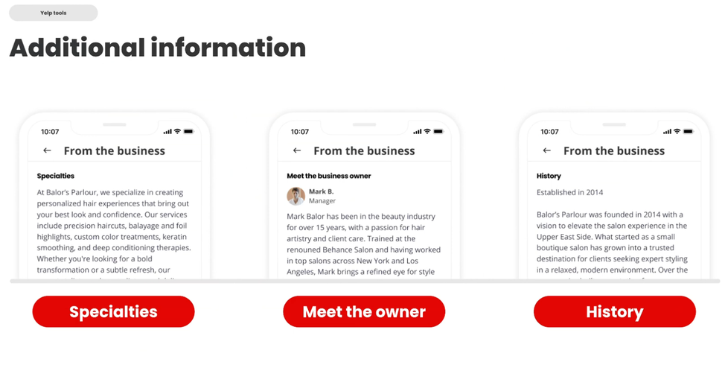
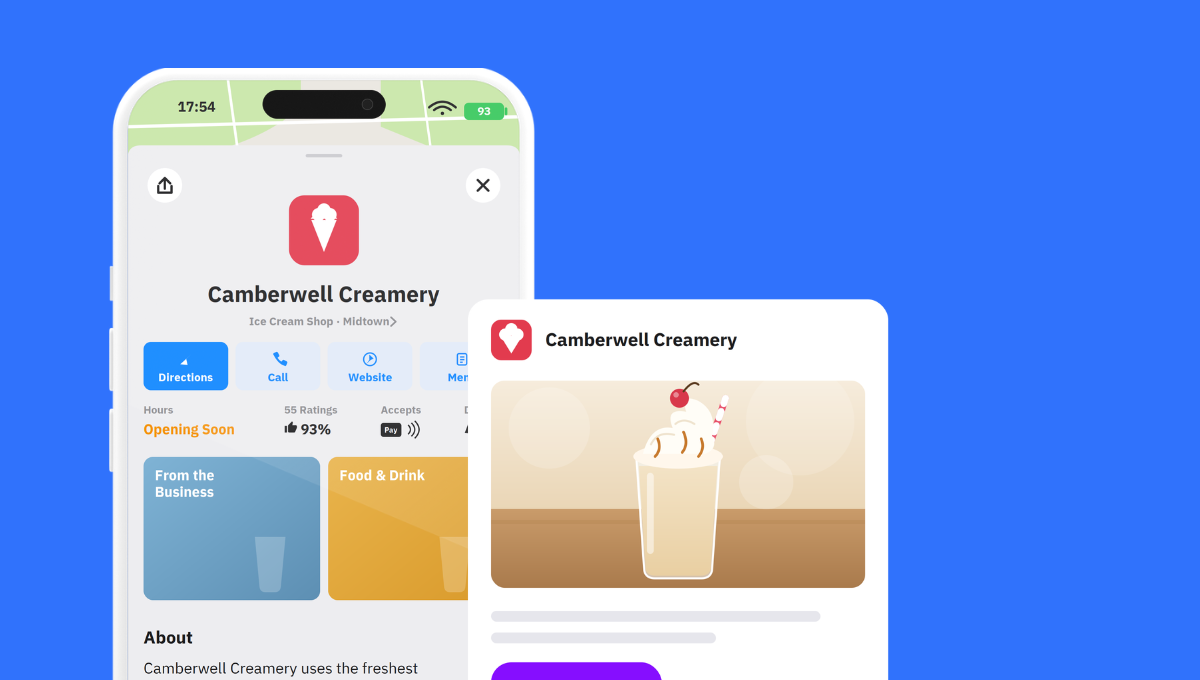
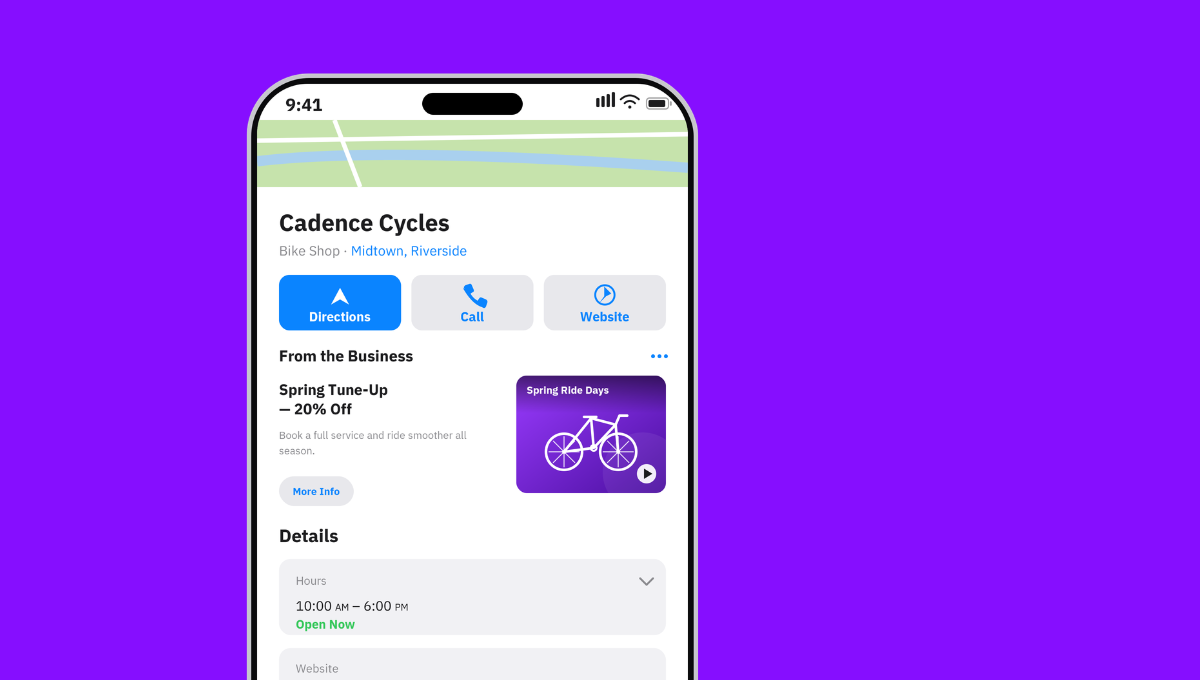
Start with the “From This Business” section, which includes your introduction, business history, and specialties. Use this space to highlight what sets you apart and weave in relevant keywords like your services and product names naturally. A note about responsible keyword usage (hopefully just a reminder): Don’t use keywords of what you don’t provide, since this is a frustrating user experience!
Even if they offer similar products or services to you, no competitor can clone the customer experience you offer. So upload high-quality photos and videos at a regular frequency – once a week – of your storefront, interior, products, dishes, team members, and recent events (for example).
Always add captions to provide consumers and AI engines with extra semantic context — especially if you sell services (like automobile repairs), rather than tangible products. Yelp even writes: “Looking at photos without captions is like watching a foreign film without subtitles.”
If you already have a Google posting workflow, repurpose the same photos and updates for Yelp to keep both channels active — and keep your life easy.
3. Respond to Reviews
Everybody who cares about your brand performing in local search is talking about reviews, and it’s for good reason.
Our friends at Yelp told us that
{{quote}}
Reviews are a local ranking factor across any search ecosystem now and help elevate trustworthy brands over lower-quality ones in rankings and recommendations. So make sure your locations are set up to actively welcome a steady stream of recent reviews, which will signal to both consumers and search systems that your business is active and relevant.
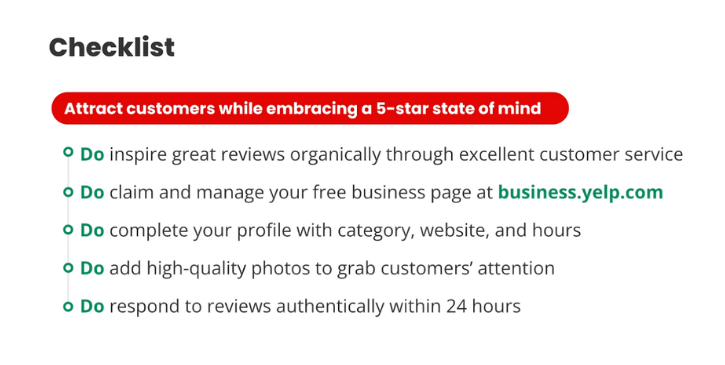
According to Yelp, you don’t need a perfect rating to attract customers. The reality is that Yelp and increasingly AI systems value authenticity and credibility over perfection. A mix of reviews, even including some critical ones, including organic, unprompted feedback can be better for trust and long-term visibility than only 5-star reviews. What’s most important is that consumers see businesses address feedback by responding to reviews.
So, to ensure this authenticity and credibility, embrace all reviews and always comply with Yelp’s guidelines: Never solicit or incentivize reviews directly.
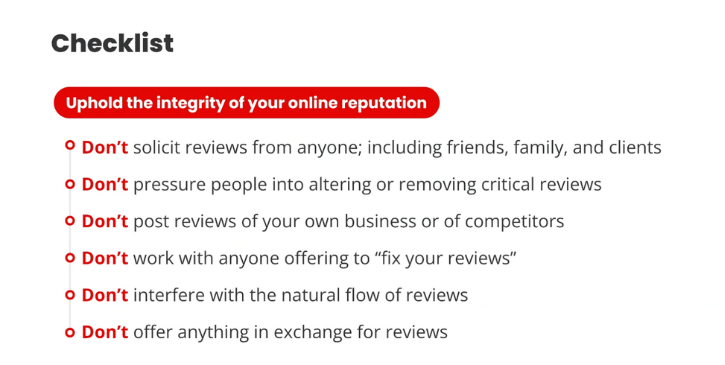
You can’t always control every customer experience, but you can always try to provide excellent service, request feedback politely, and respond politely if a customer is unhappy. When reviews come in, respond to every one — positive and negative. A simple “thank you” goes a long way for good reviews, and for critical ones, respond publicly to show you take feedback seriously, then follow up privately if needed.
Responding to reviews doesn’t only show Yelp users and search/AI engines that your business is active, engaged, and values customer feedback; it also sends those same messages to Yelp, which could help you stand out from less responsive, less active competitors.
And while you’re waiting for your next review, I really recommend you take the time to gain deep insights into how your customers perceive you — especially across AI search. You can simply type “What do customers think about XYZ, ” or even leverage tools that give you a glimpse of whether you’re perceived as “unfriendly,” “expensive,” “helpful,” “modern,” by local customers. Most multi-location brands aren’t doing this yet, which is exactly why it’s an advantage.
Perhaps most importantly, use these critical reviews to identify areas of improvement at your location to win over and retain your local customers. That is, after all, the whole point of reviews — not just to attract new customers, but to keep getting better for the ones you already have.
4. Monitor Your Locations’ Performance
Yelp has told us that businesses usually see visibility improvement when they:
- update business info
- add fresh photos
- respond authentically to reviews within 24 hours
- refine operations based on recurring feedback
So, when you optimize your Yelp listings, you can use specialized tools designed for multi-location businesses to give you insights into the most important metrics like views, click-to-call actions, map and page views, and conversions. Our own Uberall reporting feature allows you to filter this kind of data at both group and location levels.
Work with Yelp partners and advertising partners to seamlessly claim, manage, monitor, and optimize your Yelp business listings and reviews through a single easy-to-use platform, without having to do it all manually. Bonus: Get a partner that can offer you Google and Yelp listing help simultaneously.
This stage is where your Location Performance Optimization framework comes together. Everything I’ve talked about — accurate data, strong visuals, active review management, and performance monitoring — maps directly to the four dimensions that will drive your local success: visibility, reputation, engagement, and conversions.
When you track these metrics consistently across all your listings and entities, you’re building a feedback loop that makes every location stronger over time — regardless of whether customers find you through Yelp, Google, or an AI assistant.
Be Better Than Competitors: Make Yelp Part of Your Strategy
Care about your Yelp listings the way you care about your Google Business Profiles, not just as a task-to-be-done.
Keep your location data accurate, your photos fresh, your business info rich, your reviews responded to, and your locations set up to perform across visibility, reputation, engagement, and conversions. You do this, your listings are doing double duty by serving consumers directly and reinforcing your presence in traditional and AI search results.
That's a lot of return for a channel most of your competitors are probably neglecting.


1,800 brands trust us to stay visible
— not just show up once or twice in local search.





Frequently asked questions
You list your business on Yelp for free through Yelp’s business site: Search for your location in case Yelp already auto-created a page, then claim it — or add a new one — and verify ownership. From there, complete every field: address, hours, categories, website, and photos. For multi-location brands, a listings platform lets you claim and sync every Yelp page at once instead of one at a time.
Yes, Yelp business listings are free. Claiming your page and adding your address, hours, photos, and categories, and responding to reviews, costs nothing. Yelp also sells optional paid products like Yelp Ads and profile upgrades, but these aren’t required — a complete, well-optimized free listing is what does the heavy lifting for visibility in both local and AI search.
Yes, Yelp helps your SEO, both traditional and AI. Your Yelp business listing is an authoritative citation that reinforces NAP consistency; Yelp pages themselves often rank in Google for brand and category searches; and reviews are a local ranking factor. Yelp is also increasingly a data source AI search tools pull from, so a complete listing supports visibility well beyond Yelp itself.
Yes, duplicate Yelp listings can hurt your SEO: They split reviews, create conflicting NAP data, and confuse search engines and AI about which page is real, lowering local visibility. To fix them, claim your listings and report the duplicate — open the extra page, click Edit, and flag "This is a duplicate," or use Yelp’s contact form.
Yes, AI search tools use Yelp data. Yelp licenses its 330M+ reviews and business listings to OpenAI for ChatGPT, Apple Maps still displays Yelp ratings, and tools like Perplexity pull Yelp details into answers. That means an incomplete or inconsistent Yelp listing can cause AI systems to misrepresent or skip your business — so keeping it accurate shapes how AI recommends you.
You optimize your Yelp business listing by doing four things well: Keep every location’s info complete and accurate (address, hours, categories, website); showcase what sets you apart in the "From This Business" section with keyword-rich text and fresh photos; respond to every review, positive and negative; and monitor metrics like views and clicks. For multi-location brands, doing this consistently at scale is the real challenge.
Yes, you can manage Google and Yelp listings together. Instead of logging into each platform separately, multi-location brands use a listings management platform or Yelp partner to claim, update, and monitor Google, Yelp, and other directories from one dashboard. This keeps your NAP, hours, photos, and reviews consistent everywhere at once — the Google and Yelp listing help most teams are searching for.
Yes, you should list your business on Yelp, especially as a multi-location brand. Yelp has over 74 million monthly visitors, and 82% of users hire or buy from a business they find there within a week. It’s not just for restaurants — home and local services actually lead Yelp activity. With many competitors neglecting Yelp, a complete, optimized listing is a low-effort way to win high-intent local customers.