
Episode 16: How Location Marketing and Local SEO Drive Retail Success for schuh

Key Takeaways
- Localized keyword strategies for each store page — not copy-pasted descriptions — drove a 60% year-over-year increase in map impressions and doubled top-3 rankings from 15% to 31%
- Centralized listings management across 51+ directories eliminated the chaos of updating hours and information across Google, Apple, and Bing separately
- A new store in Northern Ireland ranked number one for key brand searches within three weeks of opening by having optimized content and directory links ready from day one
- Reviews play a direct role in customer lifetime value — schuh’s review response strategy feeds into their loyalty program and repeat purchase cycle
- Store locator pages should be treated with the same SEO rigor as product pages
For multi-location retailers, the gap between online discovery and in-store purchase is where revenue is won or lost. A customer searching for shoes in Manchester has different intent — and different product preferences — than one in Liverpool, even though they may be searching for the same brand. The retailers that recognize this and optimize at the individual store level are the ones seeing measurable results.
In this episode of the Local Marketing Beat podcast, host Christian Hustle sits down with Jonny Gilpin, SEO Manager at schuh, to explore how the UK and Ireland footwear retailer overhauled its location marketing strategy, why localized content for each of its 120+ stores outperforms bulk approaches, how centralized listings management solved operational nightmares, and what results the brand has seen in impressions, rankings, and engagement.
Timestamps
00:00 Introduction to Jonny Gilpin and schuh’s footwear retail business
03:01 Why location marketing matters for a 120+ store retailer
04:30 Driving online consumers to physical stores
06:27 Managing 51+ directories and the challenge before centralized tooling
07:49 Localized keyword strategy for store locator pages
10:35 AI in content strategy: when to use it and when to keep the human touch
12:47 The impact of reviews on reputation and customer lifetime value
15:06 Leveraging data: keyword performance, cross-location analysis, and technical SEO
17:06 Biggest challenges: accuracy at scale and new store openings
20:06 Results: 60% more impressions, doubled top-3 rankings, and a new store ranking #1 in three weeks
21:56 Actionable advice for retailers and what’s next for schuh
Localized Content for Every Store Is Worth the Effort
“Every store that we have in our estate has relevant content based on the searches in that area. We know in Manchester that there’s more searches for the New Balance 327 than there is in Liverpool, so we would focus the keyword there for that particular pitch.” — Jonny Gilpin
Jonny describes a content strategy that most multi-location brands skip because of the effort involved: creating unique, keyword-optimized descriptions for each of schuh’s 120+ store locator pages.
Rather than using bulk copy-paste across all locations, Jonny’s team uses Google Keyword Planner to identify which products and search terms are trending in each specific geographic area and tailors the content accordingly.
He shares the example of two stores in Ireland, roughly 100 kilometers apart, where the keyword demand for New Balance products is significantly different between the two locations.
For brands managing local landing pages at scale, this is a powerful reminder that local content should be genuinely local — reflecting the actual search behavior of the community around each store, not a generic brand description repeated everywhere. The results speak for themselves: schuh’s click-through rate for queries containing the word “store” more than doubled, from 4.8% to 11.2%.
Centralized Listings Management Solved an Operational Nightmare
“Not having that centralized platform where we could manage all of our information proved particularly challenging. The three main big ones — Apple, Bing, and Google — they all work in very different ways. There’s character limits on Google’s descriptions versus Apple, the timeframe that it takes to upload store opening hours.” — Jonny Gilpin
Before adopting a centralized location data management platform, schuh struggled with the operational complexity of maintaining accurate information across 51 directories in the UK and 33 in Ireland.
Each platform — Google, Apple, Bing — has different character limits, different update timelines, and different processes. Jonny describes a concrete scenario: When a severe storm required closing stores at short notice on a Thursday night, the team previously had to manually update each platform individually. With centralized management, the change was made once and pushed everywhere instantly.
For any multi-location brand managing listings across dozens of directories, this is a familiar pain point. The value of centralization is not just efficiency — it is accuracy. When hours, addresses, or temporary closures are wrong on even one platform, the result is frustrated customers and lost foot traffic. Jonny’s experience demonstrates why listing accuracy at scale requires tooling, not manual processes.
A New Store Ranked Number One in Three Weeks
“Within three weeks of that store being opened in Craigavon, we were already ranking position one for Converse, New Balance, UGG, and the head term shoes in that area.” — Jonny Gilpin
One of the most impressive results Jonny shares is from schuh’s new store opening in Craigavon, Northern Ireland.
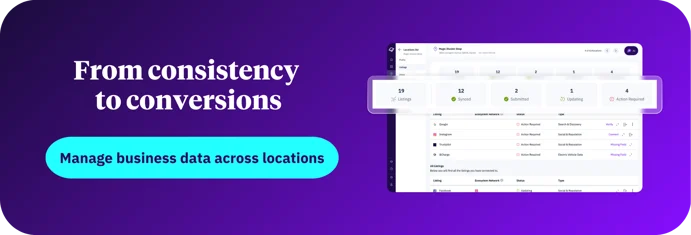
By setting up the store’s digital presence in the Uberall platform before the doors opened — with directory links built, optimized content specific to local keyword demand, and the Google Business Profile fully configured — the store was generating clicks to its locator page from day one. Within three weeks, it ranked number one for key brand searches in the area.
For brands that regularly open and close locations, this is a case study in how preparation pays off. New store openings are traditionally a weak point for local SEO because the profile has no history, no reviews, and no engagement signals.
Jonny’s approach — having everything ready before launch day — compressed the typical ramp-up period dramatically. Combined with the Uberall platform’s ability to schedule future opening dates, this model is replicable for any franchise or retail brand expanding its footprint.
Reviews Drive Reputation, Loyalty, and Lifetime Value
“Good reviews lead to that kind of lifetime value. Consumers within the UK and Ireland see schuh as a reputable footwear fashion retailer, and for that reason it’s because we have good reviews.” — Jonny Gilpin
Jonny manages Google and Trustpilot reviews personally, while schuh’s in-house customer experience team handles reviews through social channels and the website.
He describes a direct connection between review management and customer loyalty: Positive reviews build reputation, which drives repeat visits, which feeds into schuh’s recently launched loyalty program, the Shoe Club. The cycle reinforces itself — good experiences lead to good reviews, which attract both new and returning customers.
For multi-location retailers, Jonny’s approach highlights that review management is not just about star ratings or local rankings — it is a direct contributor to customer lifetime value. Responding quickly and thoughtfully to reviews, especially negative ones, demonstrates that the brand listens and cares. At scale, this requires dedicated resources and clear ownership, but the payoff extends well beyond search visibility.
Store Locator Pages Deserve the Same SEO Attention as Product Pages
“Those store pages can actually drive quite a lot of traffic. If you’re a small business and you’re trying to get after localized searches, it’s a very easy page to optimize for those local terms that doesn’t detract from your overarching SEO strategy.” — Jonny Gilpin
Jonny makes a case that many retailers overlook: Store locator pages are not secondary pages — they are often the first touchpoint for a local customer.
While most SEO attention goes to product listing pages and product detail pages (the “money makers”), store pages drive significant traffic and engagement when properly optimized. Jonny’s data backs this up: Page sessions on schuh’s store locator pages grew 26% year over year, and average session duration increased from four and a half to five and a half minutes — a strong signal that visitors are engaging with the content, not just grabbing an address and leaving.
His advice for retailers is practical: Do not neglect store pages in favor of conversion pages. Treat them with the same keyword research, content optimization, and technical SEO rigor you apply to your highest-value pages.
For brands using analytics to measure location performance, tracking click-through rate, session duration, and impressions on store pages provides a clear picture of how local content is performing — and where the next optimization opportunities are.
Ready to Transform Your Business?
Connect with our partnership team to learn how Uberall can help you achieve similar results. Get a personalized consultation and discover the opportunities waiting for your business.
.png)