Synup
Why enterprise brands switch from Synup
Built for enterprise brands, not agency resellers. Enterprise-grade governance, AI search visibility, and a 150+ directory network that scales across markets.
What You Get
increase in average revenue
directory integrations worldwide
countries with native local coverage
How it works
See the Difference For Yourself
Enterprise platform, not agency toolkit
Uberall is purpose-built for enterprise multi-location brands. From granular role-based permissions to multi-tier approval workflows and regional compliance, the platform scales with organisational complexity.
Result: Governance that grows with you, not against you.
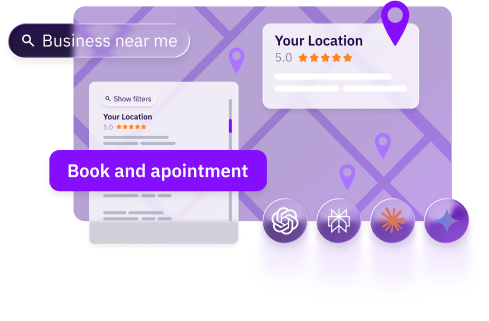
AI search visibility built in
Uberall’s GEO Studio gives enterprise brands a comprehensive suite to monitor, analyse, and optimise visibility across AI-powered search — turning a new discovery channel into a measurable advantage.
Result: Own the AI search channel before your competitors do.
Global Scale Beyond US Directories
Uberall publishes to 150+ directories across 30+ countries with native multi-language support and deep integrations with region-specific platforms across DACH, France, the Nordics, and APAC.
Result: Local relevance in every market you operate.
Unified location performance measurement
Uberall’s Location Performance Score™ and Revenue Estimator connect digital presence signals to real business outcomes — helping teams prioritise efforts based on what actually drives foot traffic and revenue.
Result: Measure what matters across every location.
See How We Compare with Synup
Features
Uberall
Synup
Omnichannel Local Marketing
Manage listings, reviews, local social, local pages, messaging, and ads in one unified enterprise platform — designed for multi-location operations across markets and languages.
Synup offers an all-in-one listings, review monitoring, and analytics platform with a central dashboard for managing data across directories. Positioned primarily as a white-label solution for agencies.
AI Search Visibility (GEO)
GEO Studio monitors and optimizes how AI search engines like ChatGPT, Gemini, and Perplexity represent each location. Entity-level optimization ensures every location is a trusted AI signal source.
Synup does not offer dedicated AI search visibility or Generative Engine Optimization tooling. Their focus remains on traditional listings and review management rather than optimizing for AI-powered discovery.
Enterprise Governance & Roles
Granular role-based access, multi-tier approval workflows, and brand governance tools designed for complex organizations with hundreds or thousands of locations across multiple markets.
Synup offers team management and white-label capabilities primarily designed for agencies managing multiple client accounts. Enterprise governance for complex multi-brand hierarchies is less mature.
Global Directory Network
Direct API integrations with 150+ directories worldwide including Google, Apple Maps, Bing, Yelp, TripAdvisor, and region-specific platforms spanning Europe, North America, Asia, and beyond.
Synup syncs and manages listings across a broad network of directories with a focus on the US market. International directory coverage and region-specific integrations are more limited.
Review Management at Scale
Centralized review monitoring, AI-powered response suggestions, sentiment analytics, and automated workflows across all locations — integrated with listings and local pages for unified presence signals.
Review monitoring and alerts from a single dashboard are core Synup features. The platform tracks reviews and provides analytics, though AI-powered response automation is less advanced than dedicated enterprise platforms.
Local Pages & Store Locator
Fully customizable, SEO-optimized local landing pages and store locator with schema markup, location-specific content, and conversion tracking — structured for both traditional and AI search.
Synup provides basic local landing page capabilities as part of its platform. The store locator and local pages offering is less mature than dedicated enterprise location page solutions.
UB-I, AI Agent for Locations
AI intelligently orchestrates actions across reviews, listings, social, content, and local pages — automating workflows that previously required manual effort across multiple tools.
No unified AI agent across the platform. Synup offers automation features for listings sync and review alerts, but lacks cross-functional AI orchestration.
Social Media Management
Multi-location social publishing with brand governance, approval flows, and AI-powered content creation. Integrated with presence data so social content reinforces location-level SEO and AI signals.
Synup includes social media posting and management as part of its all-in-one platform. Social capabilities are functional but designed primarily for agency workflows rather than enterprise brand governance.
Analytics & Performance Insights
Location-level performance analytics covering search visibility, review sentiment, competitive benchmarking, and conversion metrics. The Location Performance Score provides a unified view across all channels.
Synup provides analytics dashboards for tracking listing performance and review metrics. Reporting is solid for agency use with white-label options, though cross-channel performance scoring is less comprehensive.
Customer Support
Award-winning onboarding and ongoing support included in every plan. Dedicated customer success teams with proactive monitoring and strategic consulting for enterprise clients.
Synup is noted for its ease of use and quick setup. Support is available, though the depth of strategic enterprise partnership and proactive success management is more typical of SMB and agency-tier platforms.

Testimonials
See What Our Customers Say









Frequently Asked Questions
Synup is positioned as a white-label solution for agencies; Uberall is built for enterprise brands directly. Both cover listings, reviews, and social, but Uberall adds GEO Studio for AI search visibility, granular governance with multi-tier approval workflows, and 150+ directories spanning 30+ countries. Synup lacks dedicated GEO tooling, has a US-focused directory network, and offers less mature governance for complex multi-brand hierarchies.
No, Synup does not offer dedicated AI search visibility or GEO tooling. Their focus remains on traditional listings and review management. Uberall’s GEO Studio monitors and optimizes how ChatGPT, Gemini, and Perplexity represent your brand across locations. In Uberall’s AI tracking data, Synup has a 10-20% mention rate vs Uberall’s 30-50% depending on vertical. For brands where AI-powered discovery is a strategic channel, this is a significant capability gap.
Synup has basic local landing pages, but the store locator and local pages are less mature than what enterprise brands typically need. Uberall offers fully customizable, SEO-optimized local pages and a store locator with schema markup, location-specific content, and conversion tracking — built for both traditional search and AI search engines. If your store locator drives real foot traffic and you need to measure that, the depth difference matters.
Uberall publishes to 150+ directories worldwide through direct API integrations — Google, Apple Maps, Bing, Yelp, TripAdvisor, plus region-specific platforms across Europe, North America, and Asia. Synup covers a broad directory network too, but it’s focused on the US market. International coverage is more limited. If all your locations are in the US, both platforms cover you well. If you operate in DACH, France, the Nordics, or APAC — or plan to — Uberall’s global depth gives you a head start.
Synup is built for agencies, so its pricing reflects that — per-location, designed for reseller margins. Uberall’s pricing is modular and enterprise-scaled; teams just pick the modules they need, and support comes included on every plan. The real question isn’t cost per location — it’s what teams are getting. Uberall includes GEO Studio, local pages, UB-I, and enterprise governance natively. Synup doesn’t offer any of these.
Uberall is better built for enterprise teams — epsecially, if you’ve got HQ, regional, and local teams who all need different access levels, plus approval chains before anything goes live. Granular role-based permissions, multi-tier workflows, and brand governance come built in. On G2, Uberall scores 94% on user and access management — the highest of any competitor compared. Synup’s governance is geared more toward agency client separation.
Uberall has 4.3 stars on G2 from and is a G2 category leader in local listing management and multi-location marketing. Synup is noted for ease of use and quick setup — but its support and governance are described as "more typical of SMB and agency-tier platforms." Uberall scores 94% on user and access management and 89% on support on G2, reflecting enterprise depth. Synup serves agencies well; Uberall is built for the brands those agencies work for.
Yes, and it’s more straightforward than you’d think. Uberall covers 150+ directories worldwide, so teams are unlikely to lose coverage. Make sure to document review history before switching so nothing gets lost in the move. On G2, the average time to go live with Uberall is about 2 months, and reviewers consistently praise the onboarding — "easy and smooth, with no hiccups." Support is included on every plan from day one.