'Located in' Listings
Give Every “Located In” Business the Visibility It Deserves
When businesses share an address, most listing providers can't tell the difference. Uberall gives each location within a location its own verified digital identity, so customers searching nearby can find you, always.


Uberall is the Platform of Choice for Leading Brands Like





















How it works
Make Every Located-In Service Easy to Find
Dedicated Listings for Every Location
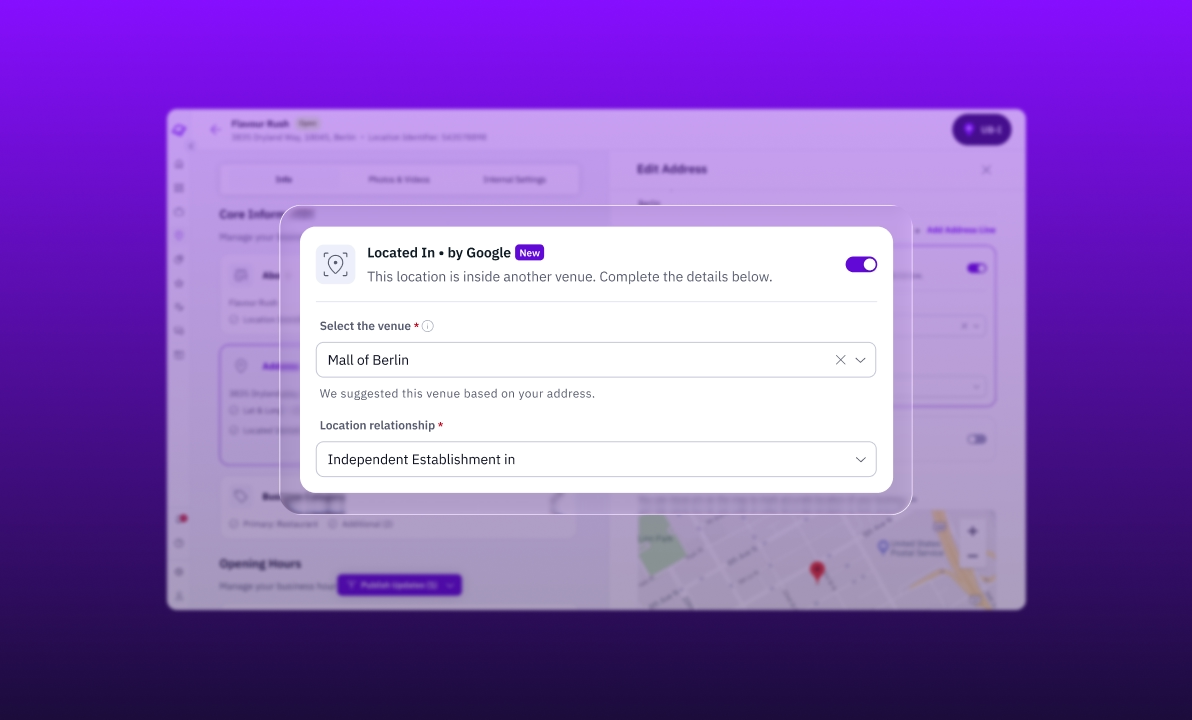
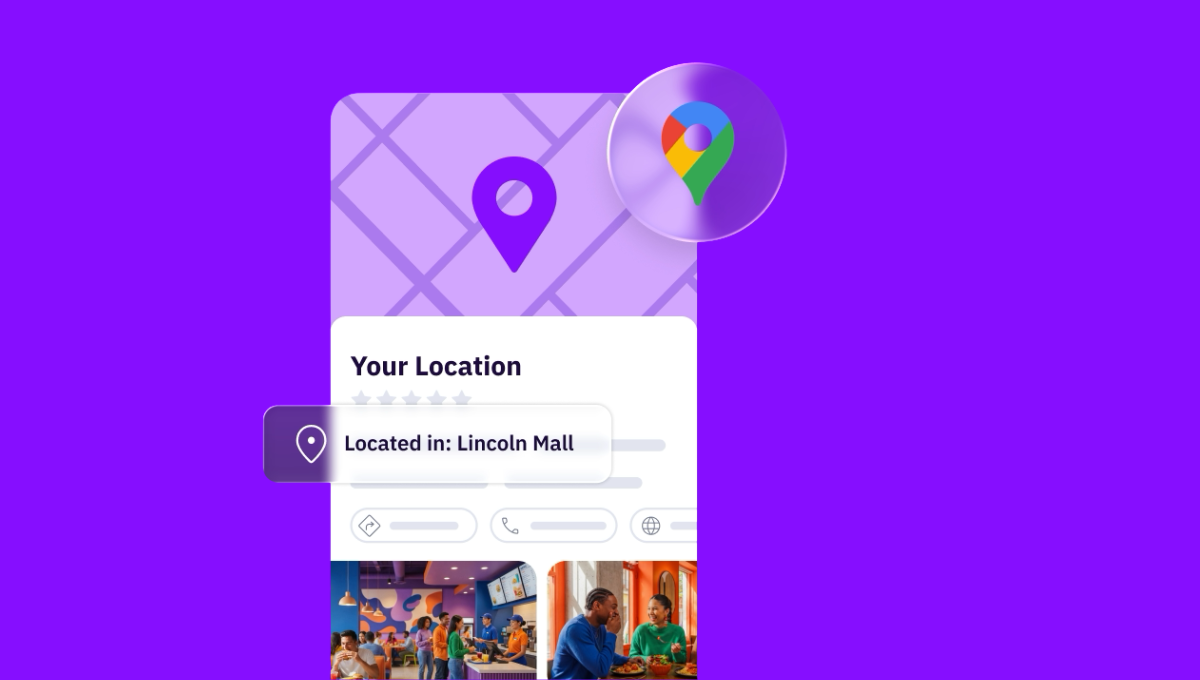
A service that shares a building with another business needs its own listing, not a footnote on someone else's. Uberall fixes that with precise, secure Location within a Location mapping.
- Creates a separate, verified listing for each co-located business or service.
- Each location appears independently in nearby searches and Google Maps
- Works for pharmacies, ATMs, kiosks, EV chargers, counters, and more
- Syncs directly to Google via native API integration
Control Hours, and Status, for Each “Located In” Business
Located-in businesses have their own opening hours, status, and availability. Uberall lets you edit each of the locations independently — without touching the parent location or waiting for manual syncs
- Update opening hours for a sub-location independently from the parent.
- Flag a service as temporarily closed or unavailable in real time
- Changes push live across Google and other directories immediately
- No risk of overwriting the parent listing's data

Promote The Kiosk. Not The Whole Building.
Sub-locations have their own unique offering. Uberall gives each co-located service its own promotional space — so every location can reach the right customers with the right message, independently.
- Publish offers and promotions at sub-location level independently
- Tailor messaging to the specific service and its customers
- Keep parent and child listing content clean and separated
Keep Every Location Protected
Shared addresses are one of the most common triggers for duplicate listing flags and suspension. Uberall declares the parent-child relationship to Google's official API — so your listings stay verified, compliant, and suspension-free.
- Removes suspension risk before it becomes a crisis.
- No manual Google Business Profile workarounds at scale.
- Compliant with Google's official Relationship Data standard from day one.
Why the Right Tool Makes All the Difference
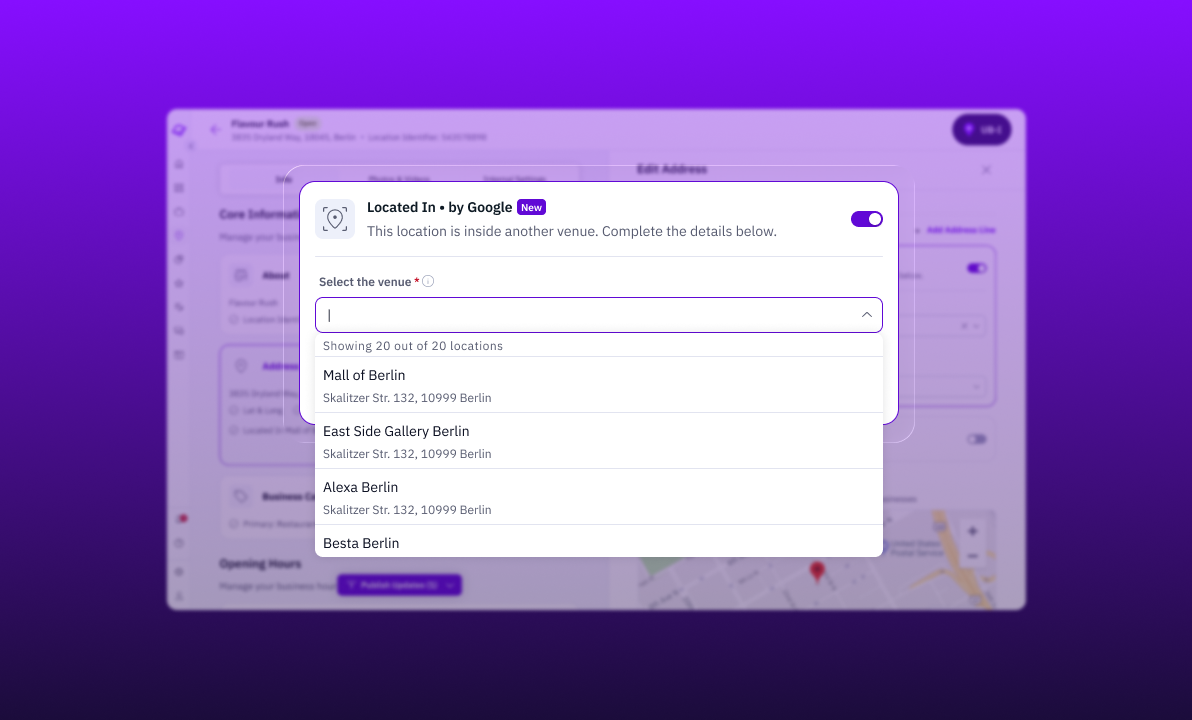
One major Uberall customer discovered that over 90% of potential customers couldn’t find their sub-location online. Their provider couldn’t handle shared-address challenges. So they switched to Uberall and solved the problem at scale.
- Uberall handles shared-address complexity that most providers can't
- Creates clean, structurally separate listings, not workarounds
- Eliminates the visibility gap between sub-location and host
Location audit
Location Marketing Audit
Enter the company name that you use across your Google Business Profiles, the country and the number of locations you want to test, make yourself a coffee and your results are there!
Business Search
AI-generated summaries can be inaccurate. Double-check important info.
NAP Scorecard
Based on 10 businesses
13% better than listed businesses
Overall Score
Listings Health
Business Name
10/10
Address
10/10
Phone
10/10
Category
10/10
Bing Places Consistency
Skipped
Apple Maps Consistency
8/10 found
Review Score
Rating
8/10 above 4.0
Review Count
10/10 have 10+
Response Rate
0%
Local Page
Website
10/10
Opening Hours
10/10
Local Website URL
10/10 local
Google Posts
0/10 active
Photos
avg 0 per location
Your personalized audit summary will appear here.
#
Name
Address
Phone
Website
Hours
Rating
Reviews
Claim
Bing
Apple
1
Albert Heijn - XL Mechelen
Nora Tilleylaan 40, 2800 Mechelen, Belgium
+32 15 69 95 00
Local
Set
4.4
1607
—
Found
—
Match
Reviews
—
Star Distribution
5 star
0
4 star
0
3 star
0
2 star
0
1 star
0
Photos
—
Posts
—
Cross-Platform Consistency
Bing Places
Matched by:
Name
—
—
Address
—
—
Phone
—
—
Website
—
—
Apple Maps
Matched by:
Name
—
—
Address
—
—
Phone
—
—
Website
—
—
Plans for Performance
Tailored Plans to Turn Search into Sales
Whether you’re managing one location or a thousand, Uberall offers flexible plans that help you capture demand and convert it into foot traffic, revenue, and results
Uberall Essentials
Listings
Level Up with these Add-Ons
Posting to Google & Apple
Analytics Plus
Collaborate Plus
39%
Revenues per click to directions.
Popular
Uberall Essentials
Listings
Review
Level Up with these Add-Ons
Posting to Google & Apple
Reviews Plus
Analytics Plus
Collaborate Plus
72%
Increase in clicks to direction

Uberall Essentials
Listings
Reviews
Local social
Posting to Google & Apple
Level Up with these Add-Ons
Reviews Plus
Analytics Plus
Collaborate Plus
55%
Revenues per click to directions.







Frequently Asked Questions
A located-in listing is a separate Business Profile for a business inside another business — a pharmacy in a grocery store, a coffee shop in a bookstore, or a service department in a dealership. Google's "Located In" feature links the child listing to the parent, showing customers exactly where to find you. Without it, businesses sharing an address compete with or get confused for their host — losing visibility to customers searching for them.
When two businesses share an address, most listing providers can’t tell the difference. A Starbucks inside a Target and the Target itself look like duplicates. Without a distinct listing, the located-in business inherits the parent’s hours, categories, and reviews — confusing customers and suppressing visibility for the specific service they’re searching for. Uberall gives each location within a location its own verified digital identity, so customers searching nearby find the right business every time.
Setting up a located-in listing means creating a separate Google Business Profile for the child business and linking it to the parent via the "Located In" field. The child needs its own name, categories, hours, phone, and photos — distinct from the host. Verification can be complex at shared addresses. Uberall handles this at scale by creating, verifying, and maintaining located-in listings across 150+ directories so every sub-location has its own optimized presence.
Located-in listings apply to any business inside another: pharmacies in grocery stores, coffee shops in bookstores, banks in supermarkets, food court restaurants, service departments in dealerships, EV chargers at gas stations, and concessions inside host retailers. Each has different hours, services, and contacts from the parent. Uberall’s store-within-a-store solution ensures each gets its own verified listing across Google, Apple Maps, and 150+ directories.
Each located-in listing creates its own local SEO footprint with unique categories, reviews, photos, and NAP data that help it rank independently. A dealership service department ranks for "oil change near me" without competing with sales. A pharmacy inside a grocery store ranks for "pharmacy near me" separately. This enhances your local visibility without cannibalizing the parent — each business captures its own search demand.
Most listing providers treat businesses sharing an address as duplicates and suppress one. Uberall recognizes located-in businesses as distinct entities deserving their own digital identity. The platform creates separate listings for each sub-location across 150+ directories, links them correctly to parents on Google, and keeps hours, categories, and contacts accurate. Your located-in businesses show up in search instead of being hidden behind their host.
For brands with hundreds of located-in locations — a pharmacy chain inside a grocery network, or a QSR brand in food courts nationwide — manual management is impossible. Each sub-location needs its own profile across Google, Apple Maps, and dozens of directories. Uberall centralizes this by bulk-creating and maintaining located-in listings across your network, sync updates in real time, and ensure every sub-location’s data stays accurate and distinct from its host.
Coffee chains and QSR brands frequently operate inside host locations — a Starbucks inside a Target, a Subway inside a gas station, a café inside an office building. Each has different hours and menus from the host, but without a separate listing, customers see the host’s details instead. Uberall’s store-within-a-store solution gives each location its own verified profile across Google, Apple Maps, and 150+ directories — so when someone searches "coffee near me," they find you, not the building you’re in.