What Are Grounding Pages: How to Build Pages That Make AI Recommend Your Local Business
Grounding pages are structured, factual landing pages that give AI systems a single, citable source of truth for each business location — making it easier for tools like ChatGPT, Gemini, and Perplexity to find, understand, and recommend you.

Key takeaways
- A grounding page gives AI a single, authoritative, citable source of truth for each location: factual, neutral, and machine-readable, not promotional
- A proof of concept showed a brand-new domain with almost no backlinks getting cited by ChatGPT, Perplexity, and Gemini within three weeks because the page was structured correctly
- Don’t copy-paste across locations, use promotional language instead of neutral facts, skip schema depth (aggregateRating, sameAs, openingHours), ignore the English-language layer for non-English markets, and fail to maintain a grounding page over time.

Ask ten marketers what "AI SEO" or "GEO" means and you'll get ten different answers. Most of them will involve adding FAQ sections to your pages or some version of "just add more detailed content."
Very few answers will mention what else AI systems need before they recommend a business: a stable, machine-readable factual foundation.
That's what a grounding page does.
When a large language model like ChatGPT or Perplexity generates a response, it doesn't just retrieve documents. It reconstructs facts from patterns. When those facts are missing or inconsistent, models fill the gaps with plausibility. That's where hallucinations come from.
A grounding page eliminates that ambiguity by giving LLMs a single, authoritative, citable source of truth for a specific entity:
- a brand
- a location
- a product/service
- or a person
For multi-location businesses, the entity in question is the location itself.
What Are the Characteristics of a Grounding Page?
The Grounding Page Standard (v1.5) was developed by German SEO expert Hanns Kronenberg. It defines an open standard for machine-readable brand identity — a dedicated HTML page that acts as a semantic anchor for AI systems. Or, in simple terms: a landing page with static facts about the location or company.
Where classic SEO optimizes pages for keywords, a grounding page curates an entity for consistent, correct brand mentions. This distinction matters.
According to the Standard, the spec defines three core elements that every grounding page needs:
- A stable definition: A short, verifiable statement describing what the entity is. No promotional adjectives, one fact per sentence.
- A clear distinction: A statement describing what the entity is not, to prevent semantic drift with similar concepts.
- Consistent structure: Same format, same logic, same extractability so AI systems can reliably pull the right information regardless of query.
Technically, a grounding page is a real HTML page under its own URL (e.g., /facts/ or /locations/city-name/), linked prominently from the footer or site navigation.
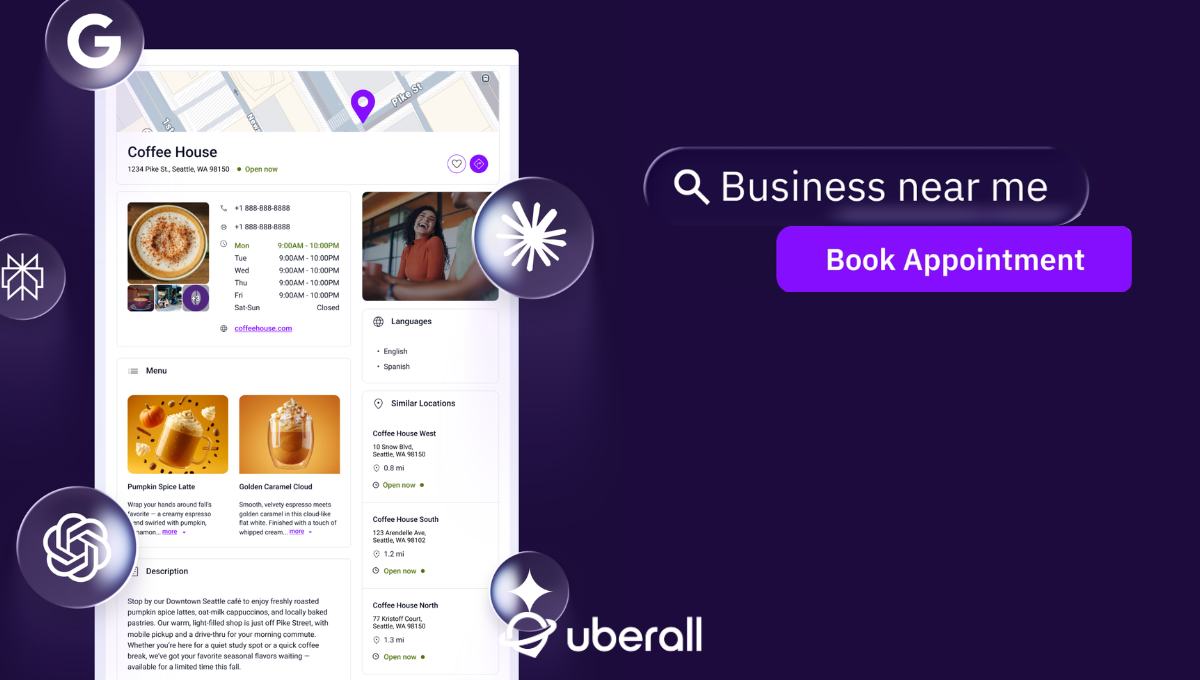
It pairs visible, human-readable content with JSON-LD structured data underneath. Written for people and machines alike, much like a Wikipedia article, the intent is descriptive and citable (i.e. neutral) rather than persuasive.
A 2025 proof of concept by the Grounding Page Project applied this standard to a brand-new domain with almost no backlinks. As a result, the domain was cited as a source in ChatGPT, Perplexity, and Google Gemini within three weeks. The size of the domain didn't matter. Structure did.
The Grounding Page Standard is essentially a factual, structured page about your business location. Not a marketing page. A fact page. One that AI systems can read, trust, and cite.
Why Grounding Pages for Businesses Need Structure, Accuracy, and Consistency
Here's the misconception that keeps local marketing teams on the sidelines: "AI visibility is for the big players."
It's understandable. If you've spent years watching domain authority and ad budgets determine who gets seen, it's natural to assume the same logic applies to AI. But it doesn't, and a simple test makes that clear.
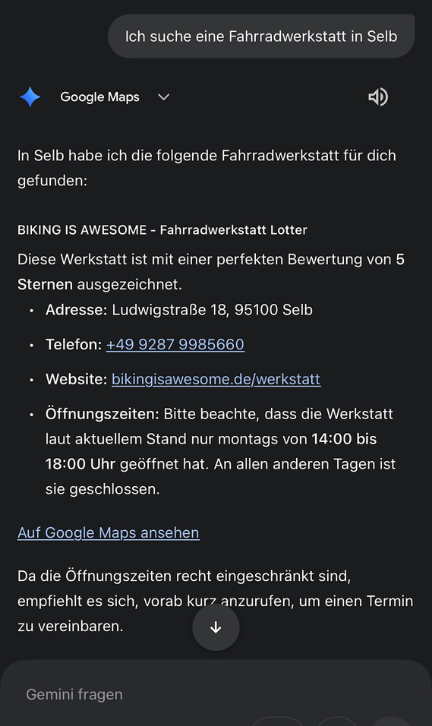
I ran the same local search query "Fahrradwerkstatt Selb" (bike repair shop Selb) across several AI tools. In other words, I asked for a specific type of service provider in a specific city, factoring in proximity, opening hours, and a general impression of the business.

Gemini offers the best data for local search, and the reason is structural.
Gemini, a Google product, draws directly from live Google Business Profile (GBP) data. A fully completed, consistently optimized GBP therefore gives any business, regardless of size, a real shot at appearing in Gemini's answers.
But there were limitations: My search results for this query were capped at a handful of entries, no map showed spatial proximity to the searcher, and any business with incomplete or inconsistent GBP data simply didn't appear.
ChatGPT and most other LLMs revealed a more fundamental problem.
Without real-time direct data access and a structured local data source to draw from, these tools couldn't answer the query reliably. No concrete local results. No opening hours. No map. In some cases, there was incorrect or outdated information. Not because the AI tool was bad, but because it had no structured, trustworthy data to work with.


This observation is backed by a scientific paper by Mahe Chen, Xiaoxuan Wang, Kaiwen Chen, and Nick Koudas (University of Toronto), Generative Engine Optimization: How to Dominate AI Search, which ran a dedicated local search experiment examining how AI systems respond to local queries.
The findings show that AI systems rely heavily on the availability of structured, machine-readable data for local queries, and that businesses without that foundation simply don't appear in AI-generated answers.
The paper identifies two key findings:
- AI agents tend to perform better with structured data over unstructured marketing content
- AI engines differ strongly in their source sets, meaning a single source of truth is never enough
Grounding pages directly address both of these.
Why Local Businesses Need Grounding Pages for Citations, Mentions, and AI Visibility
This is why third-party citations and mentions are critical. AI systems build trust in an entity by encountering the same consistent facts across multiple independent sources.
A citation is a direct reference to a page used as a source. A mention is any instance of your business name, address, or key attributes appearing across the web, even without a direct link. The more consistently these signals align, the more confidently an AI system will reference your business in a response.
Grounding pages are designed to be the central hub from which this consistency radiates. And you can build your location landing pages to complement your grounding pages; one is for your customers, while the other is for AI systems.
They don't replace your GBPs or your listings. They anchor them. A well-built grounding page gives every AI system that crawls the web a stable, structured, citable source for your location, closing the visibility gap that GBPs alone can't fill.
After all, data availability, not brand scale, determines who gets recommended.
What Data Belongs on a Grounding Page?
The spec is explicit: no adjectives, one fact per sentence, visible timestamps.
A grounding page is not a marketing page with extra schema markup. It is a factual document: precise, structured, and maintained.
Here is what a complete grounding page for a local business location should contain.
Entity Definition Block A short lead section that names the entity, assigns it to a segment ("Acme Bakery is a retail bakery in the food & beverage segment"), and states what it is not ("Hotel, Restaurant or Event venue"). This prevents semantic confusion and helps AI systems anchor the entity correctly.
This data is always complemented by the following layers:
1. Structured data layer (JSON-LD): Beneath the visible content, a JSON-LD block using LocalBusiness schema (or the appropriate subclass such as Restaurant, HairSalon, or MedicalClinic) should mirror all of the above. This is the machine-readable layer that AI systems can extract directly.
2. The English-language layer: One finding from Kronenberg's spec that catches most local teams off guard is that, according to the standard, many LLMs perform internal retrieval steps in English, even when the user's query is in another language. Adding an English version of your local landing page, or at least an English description block, makes your location more visible globally. This is not about ranking. It's about whether the model can find you at all.
The data required for an optimal grounding page largely overlaps with Uberall's Local Pages tool. Use it as your single source of truth, sync it to your Grounding Pages, and you close the consistency gap across GBP, directories, and the open web simultaneously.
Common Mistakes to Avoid When Building Grounding Pages
1. Don't Treat Them Like Regular Landing Pages
The most common mistake is building a page that looks like a grounding page but functions like a marketing page, with persuasive copy, vague descriptions, and promotional language.
AI systems favor clear, citable, factual content, so a grounding page that reads like an ad is a grounding page that may not get cited.
2. Duplicate Content Across Locations
For multi-location businesses, copy-pasting pages and swapping out location addresses is a fast path to AI invisibility. Every page needs authoritative location-specific content.
What makes one particular location different? Which services are unique to it? Who works there? Without that depth, all your locations look identical to an AI system, and it will treat them accordingly.
3. Inconsistent NAP Data
Name, address, and phone number must be 100% identical across your local page, GBP, all directory listings, and the JSON-LD markup.
"Main Street 12" and "Main St. 12" are data conflicts. At scale, across dozens of locations, these conflicts accumulate into a trust problem that no amount of content can fix.
4. Schema Markup Without Depth
Many teams add Schema.org markup, fill in name and address, and consider the job done.
Missing fields like openingHoursSpecification, aggregateRating, sameAs, and geo are missed signals. The Grounding Page spec's quality principle is simple: If the fact exists, it should be in the markup.
5. No sameAs Links
This is where AI systems verify consistency. If your local page doesn't link out to your GBP, your Facebook page, and your industry directory listings — and vice versa — the model has no way to cross-reference and confirm the entity.
sameAs is the bridge between your local page and the broader web of signals that builds AI trust.
6. Ignoring the English Layer
This is especially relevant for businesses in non-English-speaking markets.
If your grounding page exists only in German, French, or Spanish, you're invisible inside the English-language model space where many AI systems execute their internal reasoning — even for queries submitted in your local language.
7. Setting and Forgetting Your Pages
Outdated opening hours, old photos, a location listed as active that has closed — these signal unreliability to AI systems. Volatile facts should carry date stamps.
Grounding pages aren't a task to check off. They're infrastructure that needs to be maintained to keep working.
Build Grounding Pages That Are the Answer LLMs Look For
AI systems don't recommend the biggest business. They recommend the best-documented one.
For local businesses, and especially for multi-location brands, that's the most important strategic shift we're seeing in AI search. The question is no longer "How do we rank?" It's "How do we make sure AI systems can find us, understand us, and trust us enough to recommend us?"
Grounding pages answer that question. Not because they're a trick or a shortcut, but because they do exactly what AI systems need: They provide a stable, structured, citable factual foundation for every location, in every market, across every AI system that crawls the web.
The businesses building this infrastructure now are creating an asset that compounds in value with every new AI tool that enters the market. The ones waiting are letting someone else claim that ground.



1,800 brands trust us to stay visible
— not just show up once or twice in local search.


.png)

Frequently asked questions
A grounding page is a structured, factual landing page that gives AI systems a single, citable source of truth for a specific entity — a brand, a location, a product, or a person. Unlike marketing pages, grounding pages are written to be descriptive and neutral, much like a Wikipedia article. They pair visible, human-readable content with JSON-LD structured data underneath, so tools like ChatGPT, Gemini, and Perplexity can find, extract, and cite accurate information about your business.
A grounding page is built for AI systems; a location landing page is built for customers. A landing page uses persuasive copy, CTAs, and conversion design to drive bookings or visits. A grounding page uses factual, structured content — no promotional adjectives, one fact per sentence, visible timestamps — to give AI models the machine-readable foundation they need to recommend your location. Grounding pages anchor the facts; landing pages convert the traffic.
A grounding page for a local business should contain: an entity definition block (what the business is and what it is not), full NAP data character-for-character consistent with your Google Business Profile, opening hours including holiday rules, geo coordinates, primary and secondary business categories, a factual 150–300 word location-specific description, services offered at that location, at least five current photos with alt text, aggregate rating with review count, sameAs links to all verified profiles, and 3–5 location-specific FAQs.
Grounding pages do work for AI visibility. A 2025 proof of concept by the Grounding Page Project applied the standard to a brand-new domain with almost no backlinks — and the domain was cited as a source in ChatGPT, Perplexity, and Google Gemini within three weeks. Separately, a University of Toronto paper on AI search found that AI systems rely heavily on structured, machine-readable data for local queries, and businesses without that foundation simply don’t appear in AI-generated answers.
Non-English businesses should add at least an English description block to their grounding page. According to the Grounding Page Standard, many LLMs perform internal retrieval steps in English even when the user’s query is in another language. A grounding page that exists only in German, French, or Spanish may be invisible inside the English-language model space where AI systems execute their reasoning. This isn’t about ranking — it’s about whether the model can find your location at all.
The Grounding Page Standard is an open specification created by German SEO expert Hanns Kronenberg that defines how to structure a web page so AI systems can reliably extract, attribute, and cite information about a specific entity. The current version (v1.5) requires three core elements: a stable definition of what the entity is, a clear distinction of what it is not, and a consistent structure that AI systems can read regardless of query. It’s available at groundingpage.com.