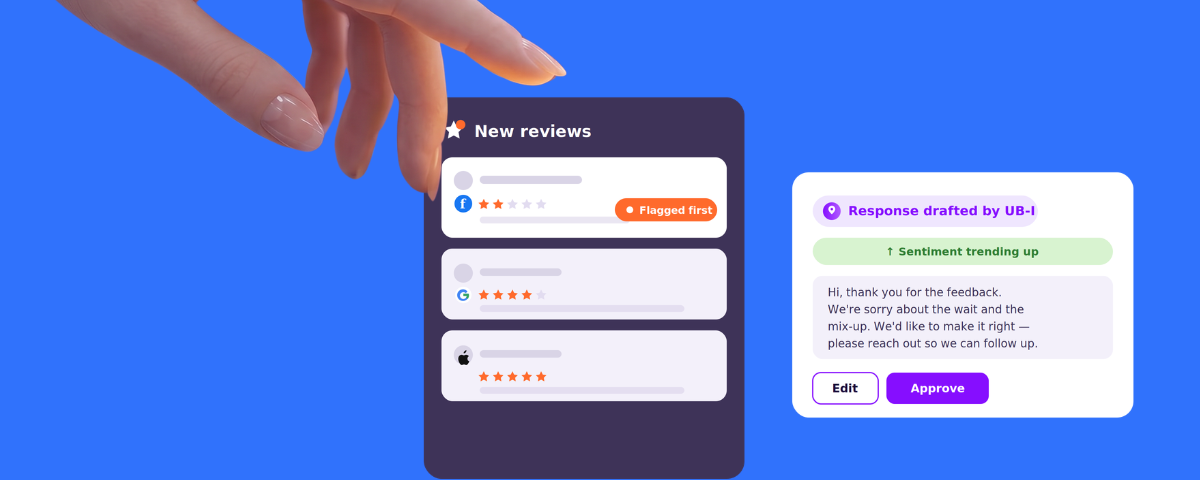
UB-I Just Got Access to Your Full Analytics Suite — Here’s What You Can Ask It
UB-I can now answer questions about your performance data in plain language — reviews, listings, search rankings, GEO Pulse, and more.

Key takeaways
- UB-I now connects to the Uberall analytics suite — reviews, listings, search rankings, GEO Pulse, social, LPS, and more.
- Instead of navigating to the right report in the Uberall platform and building a filter, ask UB-I a question directly — the agentic AI will find the information for you.
- For GEO Pulse customers, UB-I can answer questions about AI search visibility — mention rate, citation rate, competitor comparisons.
Think of UB-I as the fastest way to get an answer when you need one. Instead of sifting through reports, you can just ask UB-I to get you an answer within seconds.

I spent last week doing something I suspect every digital marketing manager does at least once a month: exporting location analytics from three different views into a spreadsheet, joining them by location, and building a pivot table to answer a question my VP asked on Slack.
The question was “Which 10 locations have the lowest review response rate and what’s dragging their performance down?” It took me 20 minutes.
UB-I, our AI agent for multi-location performance, can now answer that question in about 15 seconds.
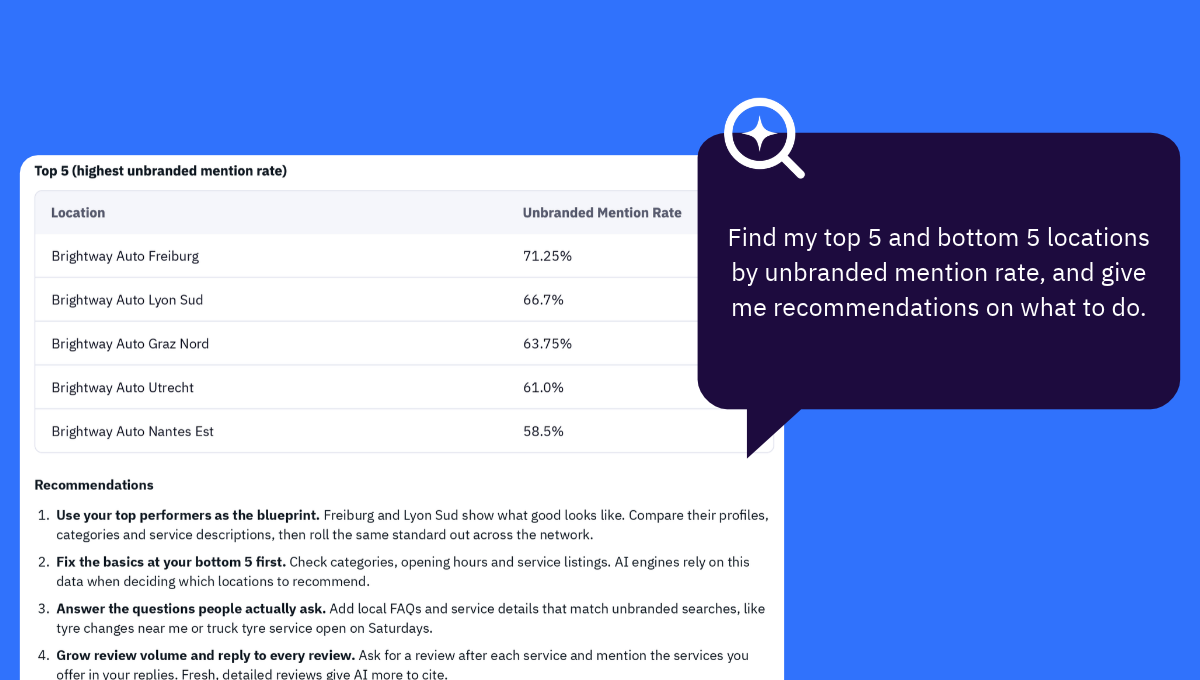
We’ve just connected UB-I to the location analytics data across your Uberall products. You ask a question in plain language (like the one above), and UB-I returns a table with the data, a breakdown, and analysis on top.
Here’s what that looks like in practice, and what you should try first.
What UB-I Can Answer Today About Your Local Analytics
UB-I can now analyze the data across your Uberall products — reviews and sentiment, listing health, profile performance, local search rankings, Location Performance Score (LPS), social post performance, and GEO Pulse.
What you can ask depends on what’s active in your account, but here are questions our customers are already asking UB-I in your chat window inside the Uberall platform:
- “What’s my average review rating per month this year?”
- “Which 10 locations have the lowest LPS, and what’s bringing it down?”
- “How many direction requests did we get last quarter compared to the quarter before?”
- “What do customers complain about most in Germany?”
- “Which competitors outrank me in local search, and what are their ratings?”
These aren’t hypothetical — they’re tested and working. UB-I sends you a data table with the local analytics numbers and writes analysis on top explaining what it found. The answer takes about 15 seconds.
What makes this different from a chatbot taped onto a dashboard is context. UB-I already knows your business — it’s monitoring your locations, your labels, your location groups, your GBP categories.
When you ask about “my franchise locations in Europe,” UB-I knows what that means — your locations in Freiburg, Lyon, and Utrecht (for example) — because it’s connected to your Uberall data across every product area.
It doesn’t just query one review report, social analytics report, or GEO report. It draws on the full picture to give you the most complete answer it can.
Ask UB-I About Your AI Search Visibility
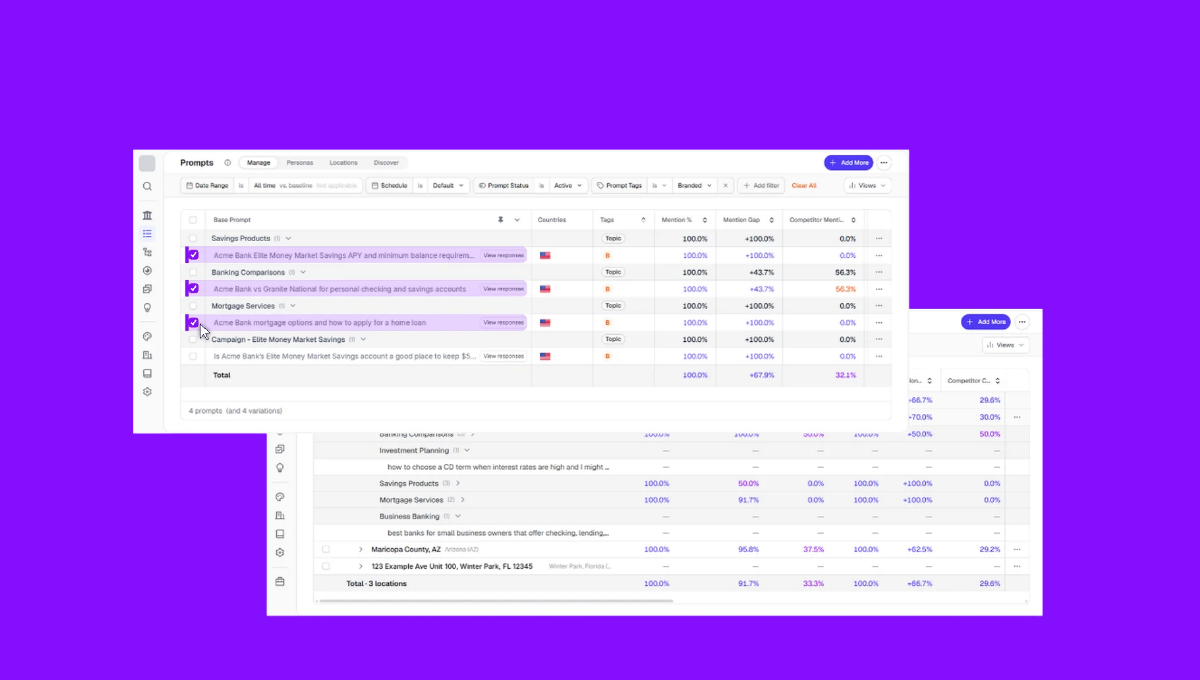
GEO Pulse is our latest tool for tracking how AI search engines describe and recommend each of your locations. It gives you a location-level map of your AI visibility, showing which locations ChatGPT, Gemini, Perplexity and other models mention and recommend, where competitors get picked over you, and what to fix first.
If your account has GEO Pulse active, UB-I can now answer questions about how you show up in AI search.
AI search visibility didn’t exist within local analytics reporting two years ago. Most brands are still figuring out how to measure it, let alone act on it. GEO Pulse gives you the data, and now UB-I lets you interrogate it in plain language:
- “What was my AI mention rate last month, and how is it trending?”
- “Which competitors are mentioned more than me in AI search?”
- “Does ChatGPT or Google AI Overviews mention me more often?”
- “Which websites do AI answers cite most for my brand?”
You don’t need to open a separate dashboard, learn a new interface, or export anything. You ask UB-I, and it answers from the same data GEO Pulse already collects.
Which Questions Should You Try First?
If you’re an admin in our Uberall platform, UB-I is ready to take your questions. Just open UB-I and start with something relevant to the products in your account.
If Your Question Needs Data from More Than One Product
Try “Can you correlate my LPS to my Google impressions?” or “What’s my average rating by label?” These are the questions that you could only answer previously by pulling review data, search data, and profile data together by location into one spreadsheet for analysis.
UB-I combines the data for you so that you don’t need to wait for the spreadsheet.
If Your Account Includes Reviews Plus
Try “What’s my average rating by country this year?” or “What are the top complaint themes in 1- and 2-star reviews?” Customers with sentiment analysis are getting theme-level breakdowns — UB-I pulls the topics and tells you what’s showing up most.
If You Track Local Search Performance
Try “How are my Google impressions trending in the last 90 days?” or “Which 20 locations had the most direction requests last quarter?”
If Your Account Includes GEO Pulse
Try “Tell me my AI citation rate for my 10 best locations?” or “What’s my AI share of voice against my competitors in Los Angeles?” This is where it gets interesting because you’re querying a data set most brands don’t even have yet.
{{quote}}
Your Data Already Has the Answers; Now You Can Just Ask
We built UB-I to be your agentic analytics co-pilot across the Uberall platform.
With analytics access, every question you used to answer with a dashboard, a filter, and a spreadsheet is now a conversation. And because UB-I has the full context of your Uberall data — from reviews, social, listings — the answers are grounded in everything your platform knows about your locations. It’s not trying to fill in gaps with hallucinated guesses.
Open UB-I and try it. Start with a question about the data you already have — whatever you asked last week that took 20 minutes and a spreadsheet. See how long it takes now.



1,800 brands trust us to stay visible
— not just show up once or twice in local search.