What Are Apple Showcases and Why Do They Matter in Today’s Search?

How do they maximize your brand reach in traditional & AI search and on Apple Maps? Discover more from our expert Miranda.

mockup of apple showcases

Edited by

Translated by

Keep us in your search resultsAdd us as a preferred source on Google

Key takeaways

  • With hundreds of millions of monthly users and pre-installed on every Apple device, Apple Maps reaches a massive audience — yet most businesses focus exclusively on Google and miss out
  • These short, visual updates on your Apple Maps Place Card average around a 40% click-through rate, letting you promote deals, events, and CTAs directly where local customers are searching
  • With OpenAI now integrated into Apple products, LLMs pull from Apple Maps data when recommending businesses — so consistent Showcase posting feeds both traditional discovery and AI-powered answers

Apple products are everywhere, with more than 2.35 billion active users worldwide. Apple Maps — pre-installed on every iPhone, iPad, and Mac — is already in your customers’ hands and attracts almost 918 million users each month.

Yet many businesses still focus almost exclusively on showing up on Google, overlooking the visibility they could be gaining on Apple.

That gap matters more than ever. In the age of AI search, large language models (LLMs) like ChatGPT pull data from across the web, so if your business isn’t present on platforms like Apple Maps, you’re less likely to appear in their recommendations at all.

That’s where Apple Showcases come in: a powerful way for businesses to stand out on Apple Maps, scale their reach, and stay top-of-mind (and top choice) for local searchers.

What Are Apple Showcases?

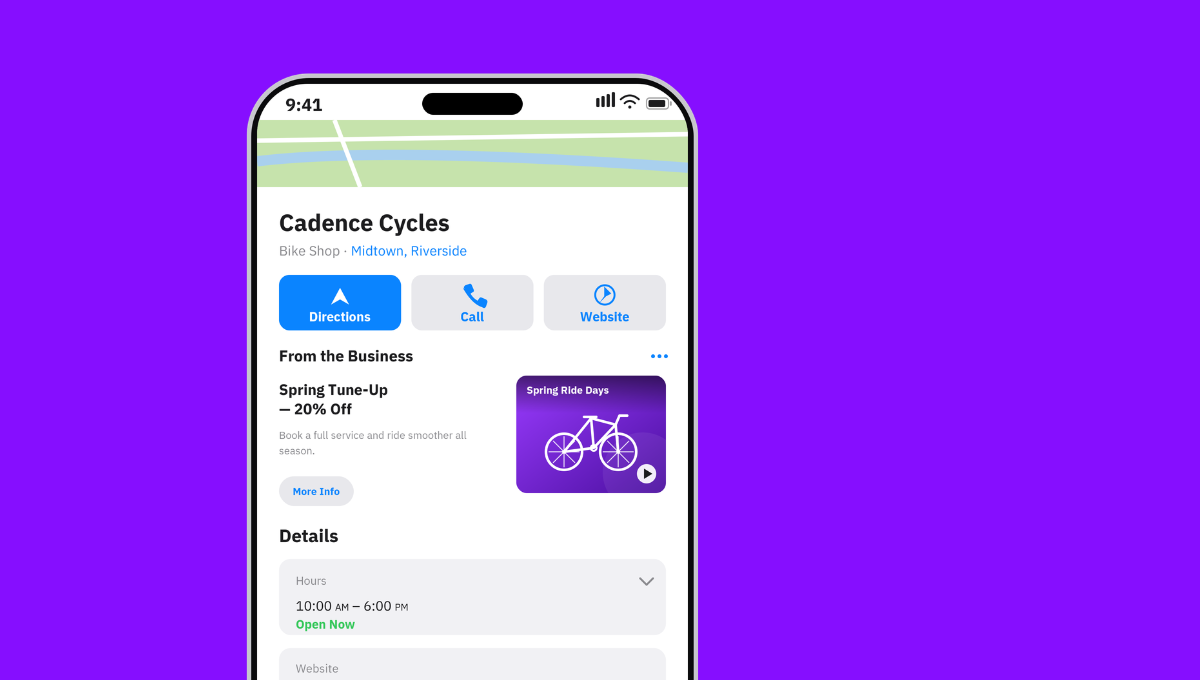
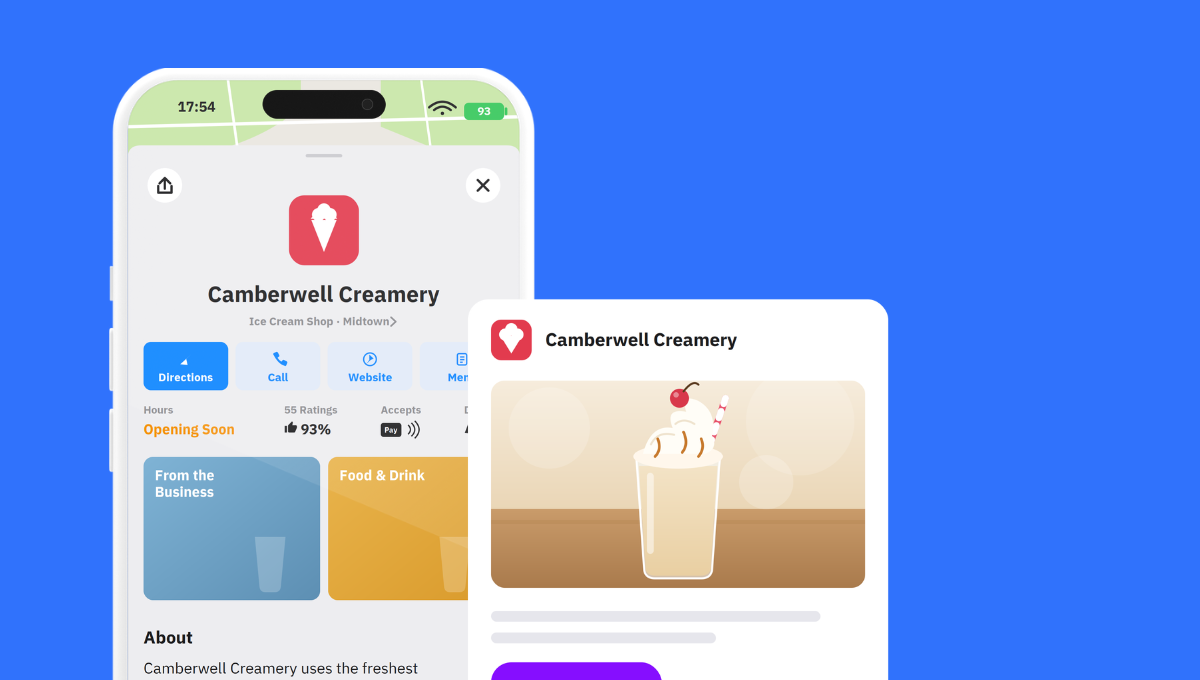
An Apple Showcase module appears on a business’ Place Card in Apple Maps. Only one Showcase can be live at a time, and it can run for up to 365 days (with a default of 90 days). Using Apple Business Connect — the platform that lets businesses control how they appear on Apple Maps and across the Apple ecosystem — you can easily create Showcases to promote new items, such as:  

  • Local deals or limited-time specials
  • Upcoming events
  • Important brand or location updates
  • Mobile app downloads

Businesses use Showcases to stand out from competitors on Apple Maps and strengthen their brand reputation in search — becoming the brand customers choose during local discovery. By keeping their Apple Maps profiles regularly optimized and customer-ready, brands stay relevant, active, and top-of-mind to both new and returning customers.

Take this real world scenario for example:

Imagine you run a frozen custard business and want to boost app downloads so customers can earn rewards for their loyalty (and enjoy some good custard along the way). You could use your Apple Showcase to promote the app directly on your Maps listing.

A few weeks later, you might update the Showcase to highlight your holiday custard flavors, helping maintain your reputation as a reliable, up-to-date, and helpful brand. When customers search for a place to eat on the holiday, your timely, relevant update could be the reason they choose you.  

What Does an Apple Showcase Look Like?

An Apple Showcase is designed to be short, eye-catching, and locally relevant — giving your listing just the right amount of visibility without overwhelming the viewer. Each Showcase includes the following elements:

1. Header

This is your title — limited to 38 characters. Make it count with clear, compelling copy that communicates your offer at a glance.

2. Body

This is where you expand on your offer — in 100 characters or fewer. It’s short, so make every word matter. Stick to plain text (no symbols or emojis) and aim to drive action or interest quickly.

3. Image

Good visuals capture the consumer’s eye, every time. But make sure you keep the visual clean — this means no overlaid text, logos, or unrelated graphics. The image should clearly support your message and follow Apple’s image guidelines.

Use a 1:1 ratio image between 492 x 492 and 4864 x 4864 pixels.

4. Actionable Links

Always include a call to action, so you maximize the conversion and click-through rates of your Showcases. Apple offers Action buttons such as:

  • Website
  • Call Now
  • Get Directions
  • Rate Us
  • Share This Place

Pro tip: Use UTM links to track how many clicks your Showcase receives.

5. Start and End Date

Through the Uberall platform, you choose when your Showcase goes live and when it ends — or you can simply let it expire after the default 90 days. As mentioned before, only one Showcase can be live per location at a time, and the dates cannot overlap  

iPhone screen showing Andy's Frozen Custard app info highlighting app download and rewards program.

Why Should I Post Business Updates on Apple Maps?

The most simple and perhaps most compelling answer to this question right now is that Showcases return an average click-through rate of around 40%. That means that, if done well, your Showcase is likely to attract — and possibly convert — two in five customers, either online or in-store.

Apple Showcases are designed to spark direct communication with local customers and draw attention to time-sensitive offers and events. Here’s why they shouldn’t be left out of your brand marketing strategy.

1. Better Organic Local Search and Engagement

Posting regularly to Apple Maps via Showcases increases customer engagement and drives more actions — from website visits to in-store traffic — especially for customers searching for local deals in the Apple ecosystem.

And the impact doesn’t stop at Maps. Your updates can also surface through Siri and other built-in Apple services on iPhones, iPads, and Macs. As natural language search becomes second nature, with more consumers vocally asking their devices for business recommendations in the area, a solid Showcase strategy gives you a stronger chance of being discovered in those key moments.

2. Superior Performance on Apple Intelligence

Apple’s new Apple Intelligence capabilities are only going to amplify this. It’s designed to deliver smarter, more personalized recommendations across its ecosystem. That means when someone asks Siri, “Where’s the best coffee near me?”, Apple’s AI will deliver answers by prioritizing businesses that are most visible in LLMs.

By publishing consistent, high-quality Showcases, you demonstrate activity and trustworthiness — signals Apple’s AI is more likely to reward with recommending you. And with OpenAI now integrated directly into Apple products, the content in your Showcases won’t just influence Maps results, but also how your business is described in AI-powered answers.

3. Greater Visibility in AI Search

This takes us naturally to what is really on everyone’s mind: We arrive at the power of Apple Showcase posting within the context of AI search.

AI engines like ChatGPT and Perplexity look for updated businesses first, with complete, contextualized, and trustworthy profiles. Your regular Showcases will help you increase your presence in recommendations and search. Especially with Apple’s new OpenAI integration.

The consistency of your brand messaging and positioning across a diverse range of sources has, for this reason, never been so important. If users ask ChatGPT, for example, “Where can I go for good donuts in downtown Manhattan?”, you’ll want to make sure your business not only appears in that list, but also that the description reflects your selling points over competitors, your products, your rating, deals, and any recent updates about that location.

This might come from a mix of sources – what your website says, what Google says, what other websites say – but it also comes from what your listings say. If all your listings, content, reviews on Google and Apple reveal that your offering is the best in the area, LLMs are going to use this to describe you. It’s not enough anymore to change only the content on your website and hope that this is how LLMs will describe you. Apple Maps therefore serves as a critical part of LLMs piecing together this kind of information about your business.

Do You Need Apple Showcases and Google Posts?

The short answer is “Yes.” Search evolves quickly and Apple’s expanded ecosystem is leaning more towards local discovery, so it’s best to focus on building the right online foundation.

Just like any new visibility feature, your success often depends on consistency. If your competitors are leveraging Showcases while your listings stay static, you risk fading into the background. Diversify how you attract customers and make sure your brand appears anywhere your consumers are searching.

Your posts don’t need to be anything flashy — focus on interesting, short, relevant, hyperlocal updates that will repeatedly foster familiarity and trust.

You’re probably thinking (fairly): “Great, another channel to post on and monitor …” But the best location marketing software helps you scale and streamline your posting efforts across multiple channels, to the right profiles at the right time, in just one click.

Uberall’s AI-powered local social management helps you write posts from scratch and analyze your past content to generate engaging, on-brand posts in seconds. In short: whether it’s Google Posts, Apple Showcases, or both, every update becomes an opportunity to connect with your local customers and bring them through your doors.  

Don't Miss Out on What Apple Showcases Can Do for Your Brand

What’s clear in today’s online landscape is that brands will have to connect with customers beyond their website — beyond the Google ecosystem.

Cohesion and clarity across platforms has always mattered a bit. But now, when LLMs are regurgitating your brand story for you — it's never been more important to get your story straight across as many channels as you can.

Apple Showcases gives you a powerful means to reach billions of Apple users and stay top of mind in Apple Maps and top of AI recommendations.  

Keep us in your search resultsAdd us as a preferred source on Google
g2 4.6 star rating reviews badge
capterra 4.6 star rating badge
software advice 4.6 star rating badge

1,800 brands trust us to stay visible

 — not just show up once or twice in local search.

Request a demo

Resources

You Might Also Find Interesting

ai generated local business description box surrounded by example reviews
Blogs
Business Review Management
Local AEO Marketing
Customer Review Sites That Influence Your AI Mentions — and Why Star Ratings Don’t Always Matter

Your online reputation can make or break your success–and since it's mainly influenced by online reviews, you should be present on top review platforms!

two phone screens showing Google What's Happening feature
Blogs
Local Listings Management
Google Marketing
Why Google’s "What's Happening" Feature Makes Google Posts More Important Than Ever

Google’s "What’s Happening" feature gives your Google Posts more prominent placement in search — and early data shows it drives real clicks. Here’s how to use it.

LLM answer mockup surrounded by screenshots of business data in search
Blogs
Multi-Location SEO
Local AEO Marketing
Local Listings Management
How Do “LLM Connections” Actually Work When You Can’t Actually Submit Your Business Data?

No listings platform submits data directly to ChatGPT or Perplexity, or any AI tool for that matter. Here’s how AI data sources actually work to influence your LLM visibility.

scattered list of multi-location marketing tasks surrounding illustration of UB-I
Blogs
Multi-Location Marketing
Uberall Product Tips
200 Tasks Across 500 Locations: UB-I Tells You Which Five Matter Most

UB-I is the AI agent that tells multi-location marketers which tasks matter most — ranked by SEO and GEO performance impact, not just urgency.

geo studio platform screenshot
Blogs
Business Review Management
Local AEO Marketing
OpenAI Licensed Access to Yelp’s Trusted Local Content: Here's What It Means for Multi-Location Brands

Yelp’s OpenAI deal changes local search: Learn how multi-location brands can win AI answers with better data, reviews and GEO.

UB-I mascot highlight issues with social media and local listings in Uberall platform
Blogs
Uberall Product Tips
Local Listings Management
10% of Your Listings Changed Last Week, But Nobody on Your Team Noticed

Listing drift — hours changing, pins moving, competitor edits — happens constantly and most teams don’t catch it in time. Here’s how UB-I’s intelligent monitoring closes that gap.

screenshots of UB-I with UB-I character
Blogs
Multi-Location Marketing
Uberall Product Tips
Multi-Location Teams Are "Babysitting" Their AI Marketing Assistants and Now They Have More Work Than Before

AI marketing assistants were built for one location, one task at a time. Here’s why multi-location brands need an AI agent that works without being prompted — and how UB-I delivers that.

replications of google search and console for local and organic SEO
Blogs
Multi-Location SEO
Local SEO vs Organic SEO: The Ranking Factors Aren’t the Same, But AI Search Reads Both Before It Recommends You

Local SEO and organic SEO have always run on different ranking factors. AI search doesn't pick a side — it reads both before deciding whether to recommend you.

screenshot of google business profile categories and attributes
Blogs
Local Listings Management
Google Marketing
Local AEO Marketing
Your Google Business Profile Categories Haven’t Changed Since Setup, But Their Audience Has

Google categories and attributes have changed jobs: they are now the structured facts AI search reads when deciding whether to recommend you. Here is how to manage them — per location, at scale.

hand clicking on AI assisted review responses
Blogs
Franchise Brands
Business Review Management
Reviews Are Franchisees’ Biggest Pain Point — and the One They Least Use AI to Fix

Reviews are franchise locations’ #1 pain point — and the task they least use AI to manage. Here’s how to run franchise review management that works.

Previous
Next

Frequently asked questions

An Apple Showcase can run for up to 365 days, with a default duration of 90 days. You set the start and end dates when you create it. Only one Showcase can be live per location at a time, so plan your rotation to keep your Apple Maps listing fresh without gaps in coverage.

An Apple Showcase headline is limited to 38 characters and the body to 100 characters, according to Apple’s documentation. The image must be a 1:1 ratio between 492×492 and 4,864×4,864 pixels, with no overlaid text or logos. These tight limits mean every word counts, so write a clear headline and use the body to drive a specific action.

Apple Showcases and Google Posts serve similar purposes — promoting offers and updates on your business listing — but they work differently. Showcases run for up to 365 days and are built for evergreen, brand-level messaging, while Google Posts are shorter-lived and suited to timely announcements. Showcases also require Apple’s approval (up to 3 days), whereas Google Posts go live almost immediately after automated review.

You can only run one Apple Showcase per location at a time, and scheduling dates cannot overlap. If you want to promote a new offer, you’ll need to wait for the current Showcase to end or manually end it early. For multi-location brands, each location can have its own active Showcase, so you can tailor promotions to what’s relevant locally.

Apple Showcases contribute to the signals AI models use when recommending businesses. LLMs like ChatGPT pull data from multiple sources — your website, Google, and your listings on platforms like Apple Maps. Keeping your Showcase updated signals activity and trustworthiness, which Apple Intelligence and OpenAI (now integrated into Apple products) factor into their recommendations.

Apple offers several CTA buttons for Showcases, including Website, Call Now, Get Directions, Rate Us, and Share This Place. Some actions — like ordering or reserving — are available only through the Business Connect API and third-party integrations. Choose a CTA that matches your goal: Get Directions for foot traffic, Call Now for immediate conversions, or Website to drive online engagement.

Yes, every Showcase is sent to Apple for review before it’s published. The review process can take up to three calendar days, so plan your scheduling accordingly. If any content is rejected for a single language, the entire Showcase is rejected. Make sure your images and copy follow Apple’s content guidelines before submitting.

Managing Showcases manually across hundreds of locations isn’t practical. A location marketing platform lets you create, schedule, and publish Showcases to the right profiles at the right time from a single dashboard. Uberall’s local social management tool can also generate on-brand Showcase content using AI, so you stay consistent without the manual overhead.

An Apple Showcase can run for up to 365 days, with a default duration of 90 days. You set the start and end dates when you create it. Only one Showcase can be live per location at a time, so plan your rotation to keep your Apple Maps listing fresh without gaps in coverage.

An Apple Showcase headline is limited to 38 characters and the body to 100 characters, according to Apple’s documentation. The image must be a 1:1 ratio between 492×492 and 4,864×4,864 pixels, with no overlaid text or logos. These tight limits mean every word counts, so write a clear headline and use the body to drive a specific action.

Apple Showcases and Google Posts serve similar purposes — promoting offers and updates on your business listing — but they work differently. Showcases run for up to 365 days and are built for evergreen, brand-level messaging, while Google Posts are shorter-lived and suited to timely announcements. Showcases also require Apple’s approval (up to 3 days), whereas Google Posts go live almost immediately after automated review.

You can only run one Apple Showcase per location at a time, and scheduling dates cannot overlap. If you want to promote a new offer, you’ll need to wait for the current Showcase to end or manually end it early. For multi-location brands, each location can have its own active Showcase, so you can tailor promotions to what’s relevant locally.

Apple Showcases contribute to the signals AI models use when recommending businesses. LLMs like ChatGPT pull data from multiple sources — your website, Google, and your listings on platforms like Apple Maps. Keeping your Showcase updated signals activity and trustworthiness, which Apple Intelligence and OpenAI (now integrated into Apple products) factor into their recommendations.

Apple offers several CTA buttons for Showcases, including Website, Call Now, Get Directions, Rate Us, and Share This Place. Some actions — like ordering or reserving — are available only through the Business Connect API and third-party integrations. Choose a CTA that matches your goal: Get Directions for foot traffic, Call Now for immediate conversions, or Website to drive online engagement.

Yes, every Showcase is sent to Apple for review before it’s published. The review process can take up to three calendar days, so plan your scheduling accordingly. If any content is rejected for a single language, the entire Showcase is rejected. Make sure your images and copy follow Apple’s content guidelines before submitting.

Managing Showcases manually across hundreds of locations isn’t practical. A location marketing platform lets you create, schedule, and publish Showcases to the right profiles at the right time from a single dashboard. Uberall’s local social management tool can also generate on-brand Showcase content using AI, so you stay consistent without the manual overhead.