Is Your Healthcare Brand’s Local Search Performance Looking a Little Sickly?
Want to boost your business’s vital signs? In healthcare, visibility and trust go hand in hand — and it all starts with getting your listings right.


“Where are the best opticians near me in Downtown Seattle?”
“Where is the nearest walk-in clinic in Southend Boston?”
“Which is the best general practitioner accepting Medicare insurance in Tampa?”
Healthcare businesses rely on a mix of urgent and proactive high-intent local searches to bring patients through their doors. They rely on trust, authority, and reputation.
These businesses are not coffee shops. Patients searching for these businesses are searching for care and apply more scrutiny than almost any other consumer category, which means healthcare brands can’t be complacent with their visibility and reputation online.
Location data and listings management is often a mess for multi-location health businesses — with outdated hours on Google, specialties listed differently across directories, insufficient directory coverage, or a lack of detailed location-specific information. If this information isn’t complete, verified, and consistent everywhere, the diagnosis for local search visibility (especially in AI search) will be bleak.
The more locations you manage, the more room there is for data to become rundown and in need of revival. That’s why we’re prescribing smarter listings management for healthcare businesses.
Optimize Location Performance with Smarter Listings Management
Again, trust is the deciding factor between a patient booking with you or the practice across the street — whether it’s the local chiropractor or dermatologist.
That’s what makes the practice of Location Performance Optimization (LPO) so critical for multi-location health brands. It’s the strategy of aligning everything that search engines and AI platforms reward — accurate data, strong reputation, active engagement — with everything patients actually expect when searching for care.
When healthcare brands get this healthcare marketing strategy right, when they chip away at measures to boost their performance across visibility, reputation, engagement, and conversions, their brand isn’t just present in search. They’re recommended, trusted, and chosen. Consider these next tips part of your strategy.
How Do Healthcare Improve Their Listings Management?
1. Ensure Consistent, Accurate Listings Across Platforms
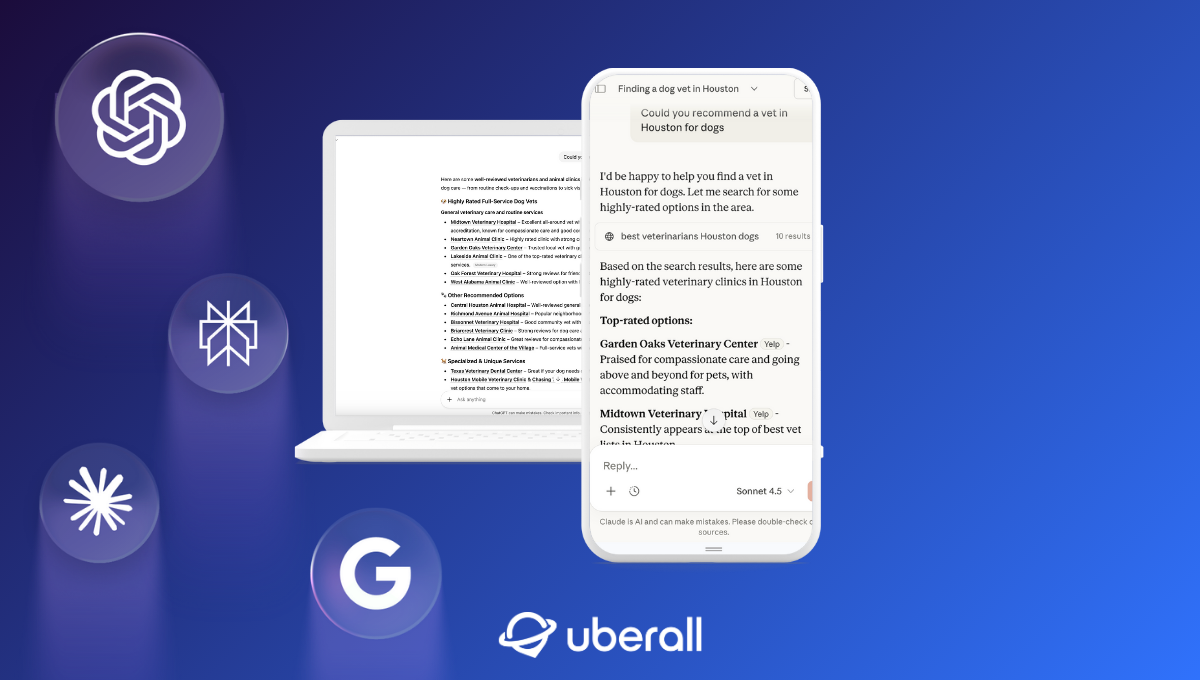
When AI platforms answer a patient’s search query “Where can I get my eyes tested for free in Downtown Seattle,” they don’t just pull from your own website. LLMs retrieve information from a mix of sources — directories, review platforms, maps, third-party health sites — and synthesize it into a single answer. If those sources are conflicting in any way because of inconsistencies, the LLM will move on to a competitor whose data is cleaner to present.
So, start by getting the basics right. Optimal listings management for healthcare brands includes locations all being present and updated across the following ecosystems:
- Google — include hours, photos, services, booking links, and Q&A
- Apple Maps — important as Siri and Apple Intelligence pull from it directly
- Bing — still a significant data source for AI platforms
- Yelp — a key reputation and discovery platform, especially for local searches
- Health-specific directories — where patients actively research providers and where AI pulls clinical credibility signals from
Every location needs accurate hours, verified specialties, the right contact details, and enough depth of information to signal credibility.
For multi-location brands, keeping all of that consistent and up to date across dozens (or hundreds) of locations is where things get complicated fast. For healthcare marketing teams already stretched thin, always-on monitoring isn’t possible (certainly not at scale) without top AI-driven listings management assistants. They continuously scan your listings data across every location, flagging errors before they cost you a patient, and fixing them automatically.
2. Build Content to Reflect Your Services and Activity
Then there’s hyperlocal content — for healthcare, this is where you distinguish your medical expertise or quality service from your local competitors’.
AI search rewards specificity. A page that speaks to “where to get prescription sunglasses in Downtown Seattle” will outperform a generic, stale opticians services page every time. The more your content reflects the real, local, even seasonal needs of the patients you serve, by location, the more likely AI systems are to surface you as the answer when it matters most. The more likely patients will trust your active, helpful, responsive business.
The depth of information you publish matters a lot. Insurance acceptance, accepted payment methods, accessibility details, condition-specific services, medical equipment, languages spoken by practitioners — the more context you give AI (and the patients behind the queries), the stronger brand engagement, reputation, and conversions will be.
Freshness is another trust signal that healthcare brands consistently underestimate. A profile that hasn't been updated in months — no new posts, no seasonal health information, no recent activity — sends a message that this location isn't on top of things. Data suggests 95% of pages cited by generative-AI systems were updated within the last 10 months, meaning that you should refresh your content every few months.
Freshness might mean executing the following for better listings management:
- Google Posts — share seasonal health updates, service changes, or local clinic news to signal activity to both patients and AI
- Review responses — acknowledging feedback (more on this below) shows patients and search platforms alike that someone is listening
- Fresh images and videos — updated visuals of your locations, staff, and equipment keep profiles feeling current and credible
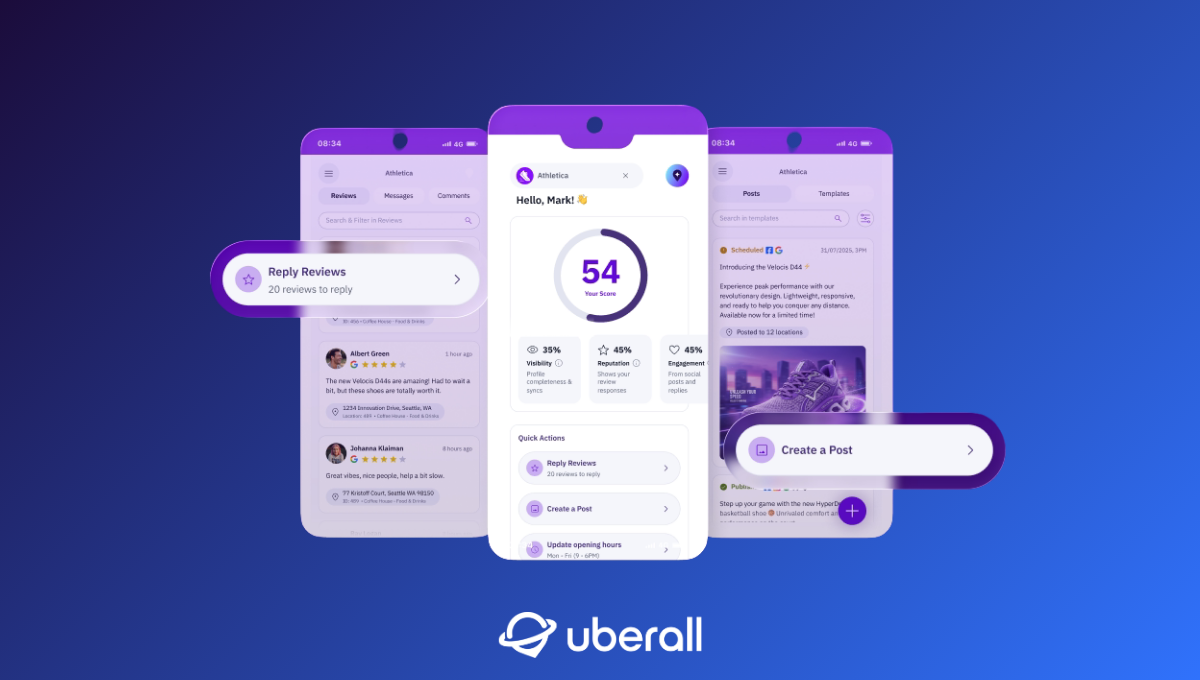
For multi-location brands, publishing timely, location-specific content at scale is where things typically fall apart — teams require local social management tools to do the heavy lifting. From being able to easily create and distribute on-brand posts across hundreds of locations at once, with dynamic fields that personalize content for each site.
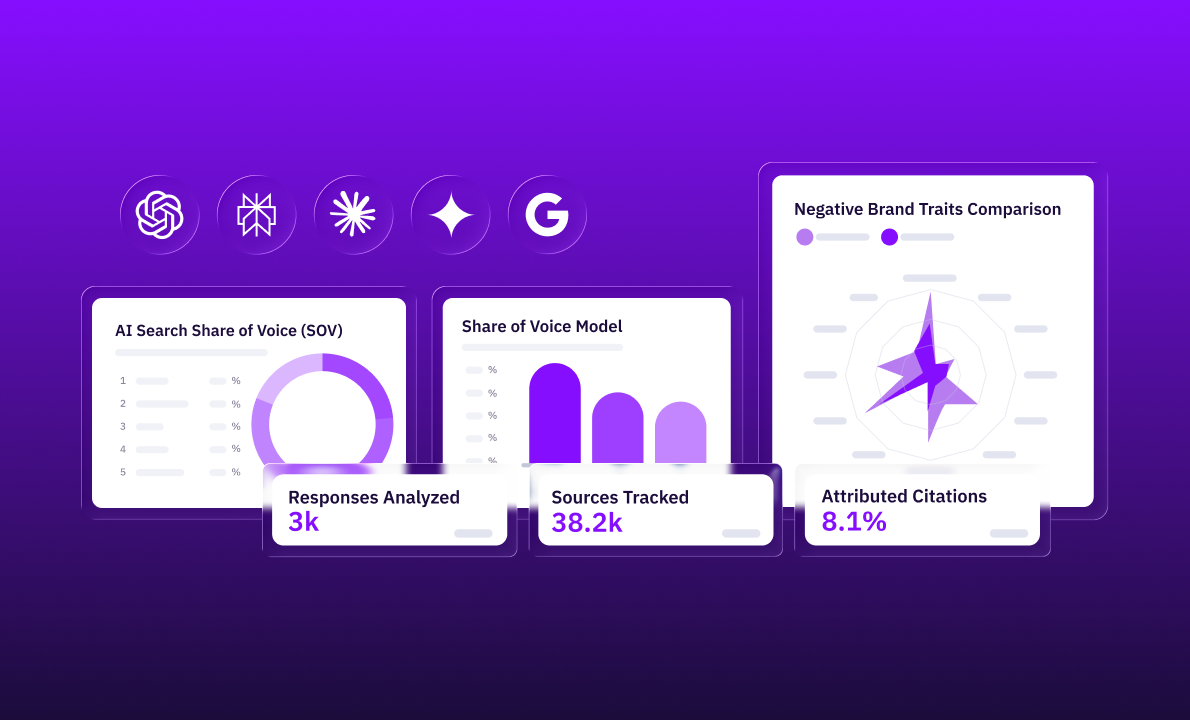
Uberall’s GEO Studio identifies exactly where brands are missing from AI-generated local business recommendations, then helps you create the quality location-specific content needed to close those gaps — across ChatGPT, Gemini, Perplexity, and beyond.
3. Build Strong Local Landing Pages and Conversion Paths
Think about what happens after a potential patient finds you in their search results.
They won’t just take the recommendation at face value — they’ll want to know more. Where exactly are you? What do you treat? Are you accepting new patients? Do you take their insurance? Do you take phone or online bookings? If the page they land on is a generic homepage with no clear answers, you've already lost them.
Whether you have a single location or hundreds, local landing pages — one per location, built with rich, specific, and structured information that speaks to that specific community — are the foundation of a strong conversion path. Prominent booking links, clear CTAs, and contact information on these pages are what converts consumer discovery into real patient visits.
AI-powered locator and local page platforms are purpose-built for teams to build and launch optimized local pages for every location at scale, without needing to write a line of code. Teams save hours when pages automatically sync with your listings data, so when hours change or a new service is added, everything stays current without a manual update cycle. The result is a network of local pages that are always accurate, always relevant, and always ready to turn a search into a booked appointment.
4. Be Responsive with Reviews
Proactive and efficient review management is nonnegotiable for healthcare businesses.
It's worth remembering that a patient who books because of a glowing review is often also willing to leave one, but only if someone makes it easy and asks at the right moment. It’s worth remembering that review management is a key local ranking factor across Maps, organic search, and AI search.
But a missing star rating, an unanswered review, or a profile that hasn’t been touched in months sends a signal — to patients and to AI alike — that something might be off. The good news is that detailed patient reviews across platforms (Google, Yelp, WebMD) and responsive profiles are not just manageable but scalable for healthcare brands with multiple locations.
The operational gains from getting review management right are significant. One of our clients collected reviews from all 60 locations into a single dashboard, where they could be monitored, flagged by sentiment, and responded to — automatically or manually — at scale. The team saw the following results when increasing their review response rate from 52% to 90%:
- 19% increase in Google Business Profile phone clicks
- 19% increase in directions clicks from Google Business Profile
- 11% increase in website visits
- 28% rise in Google Maps views
Consistent reputation management generates more trust, more visibility, and more patients walking through the door.
5. Add High-Quality Images and Videos
Photos of a clean, welcoming reception area, friendly staff, and modern treatment and waiting rooms will be among your strongest conversion tools. The same goes for equipment.
For multi-location healthcare brands, the investment in location-level visual content — real photos, not stock imagery — signals trust and human-oriented care in an online journey where patients research more carefully than almost anywhere else.
A practice that’s invested in the latest diagnostic technology or treatment infrastructure should be showing it off. For a patient weighing up two clinics in the same area, images of approachable staff and state-of-the-art equipment could be the deciding factor. Likewise, walkthrough videos give potential patients short online insights into how they will feel as a patient in your care – engaging with this content will make them confident and at ease when they come to visit.
The Prescription for a Healthier Local Presence
For healthcare businesses — especially those with multiple locations — poorly managed listings erode the trust that the entire patient relationship is built on. The good news is that the prescription is actionable and scalable with the right tools behind your team:
- Ensure consistent, accurate listings across platforms — so AI and patients find the same reliable information everywhere they look
- Build content that reflects your services and activity — specific, local, and fresh content is what gets you recommended and trusted
- Build strong local landing pages and conversion paths — because the page they land on has to convert
- Be responsive with reviews — reputation is a ranking signal, and an unanswered review is a missed opportunity
- Add high-quality images and videos — show patients what to expect before they’ve ever walked through your door
Listings management doesn't need to be difficult to scale, but it does need to be clinical — consistent, accurate, and active — to avoid the quiet erosion of patient trust.
Ready to Transform Your Business?
Connect with our partnership team to learn how Uberall can help you achieve similar results. Get a personalized consultation and discover the opportunities waiting for your business.