Local Listings Management: Does It Matter Anymore?
With so many SEO tactics and measures in use, how much do listings and citations matter today? Dive into the importance of business listings for local SEO.



For years, online business listings have been a cornerstone of effective SEO, helping brands boost visibility and attract potential customers. But as marketing conversations shift toward trendier tactics—social media, AI-driven personalization, and hyper-targeted ads—it’s easy to wonder: Do listings still matter?
With so many flashy tools promising to supercharge local search rankings, where do business listings fit in today’s SEO landscape? And more importantly, how can brands maximize their impact? At Uberall, we’ve explored these questions in depth and now share key insights and strategies for making listings management a powerhouse in modern SEO.
What Exactly Are Local Listings—And Is it the Same As Local Citations??
Technical jargon is commonplace in SEO—and when it comes to listings, even seasoned digital professionals can confuse a handful of similar yet distinct terms.
What is a Business Listing?
A business listing is an index entry for a business, including its name, address and telephone number (known collectively as “NAP data”), in a structured format. It usually appears as part of a directory, a website with structured records for numerous businesses, organized to facilitate simple and convenient user searches.
At Uberall, we often use the term local listing, though, to emphasize the importance of listing each individual store operated by a multi-location brand.
What is a Local Citation?
Business listings are a form of citation, which occur when a business is referenced—along with its contact details—outside its own website. A directory listing is an example of a structured citation, while a blog article with a reference to a brand’s store—including its contact details—is an unstructured citation.
What’s important to know: both types of citations contribute to online visibility. However, structured citations—meaning business listings—usually fall under the proprietor’s control, so marketers can shape them directly. Got it
The Importance of Listings for Online Visibility
Business listings impact online visibility in complex and multifaceted ways. For the sake of simplicity, let’s break down their value into three levels.
Level 1: An Accessible Format for Customers
First, listings offer value by ensuring that consumers can access crucial information about your business when they need it. So listings represent a pivotal step in the customer journey, assisting customers in making the leap from online to offline, and contributing to a seamless customer experience.
Hence, you should create and claim listings for all your brand’s locations, with complete contact information and details of their opening hours. This removes barriers and paves the way for customers to visit your brick-and-mortar stores. After that, you can seek to enrich your listings on relevant directories with high-quality images and descriptions.

Level 2: A Broad Footprint to Drive Engagement
According to a recent BrightLocal study, business listings account for 37% of all results for local searches with an informational intent. So maintaining listings across numerous directories brings you to the top of search, to be found by ready-to-buy customers.
The biggest listings platforms include well-known names like Google Business Platform, Apple Business Connect, and Yelp. However, you shouldn’t neglect niche sites, as industry-specific directories can prove valuable sources of footfall.
Of course, your location counts as a critical factor in determining the most relevant directories. Check out our guides to the best business directories in the UK, the leading directories in the USA, and the 25 listings sites that multi-location businesses can’t afford to miss.
Level 3: A Clear Signal of Credibility
Listings with accurate, up-to-date information about your locations present an excellent first impression to potential customers. Even more than that, a wide array of consistent listings also sends clear trust signals to search engines.
Google’s local search algorithms, for example, assess accurate and consistent listings as demonstrations of authority—which they then reward with greater visibility in search results.
This SEO boost represents the longer-term value of listings management. By ranking higher in search results—and increasing your chances of breaking into the Google 3-Pack—you enjoy greater prominence.
How Accurate Listings Foster Consumer Trust
Given their ability to shape customers’ initial perceptions of a brand, business listings represent crucial pieces of online real estate, laying solid foundations for more targeted reputation management. So besides providing essential information, listings also play a major role in building trust at an early juncture in the customer journey.
Think about your own experience looking for information on local businesses online. An effective listing that offers all the information you need, along with a detailed description of what you can expect, immediately radiates competence and professionalism. Rendering assistance even at this early stage signals a customer-centric mindset.
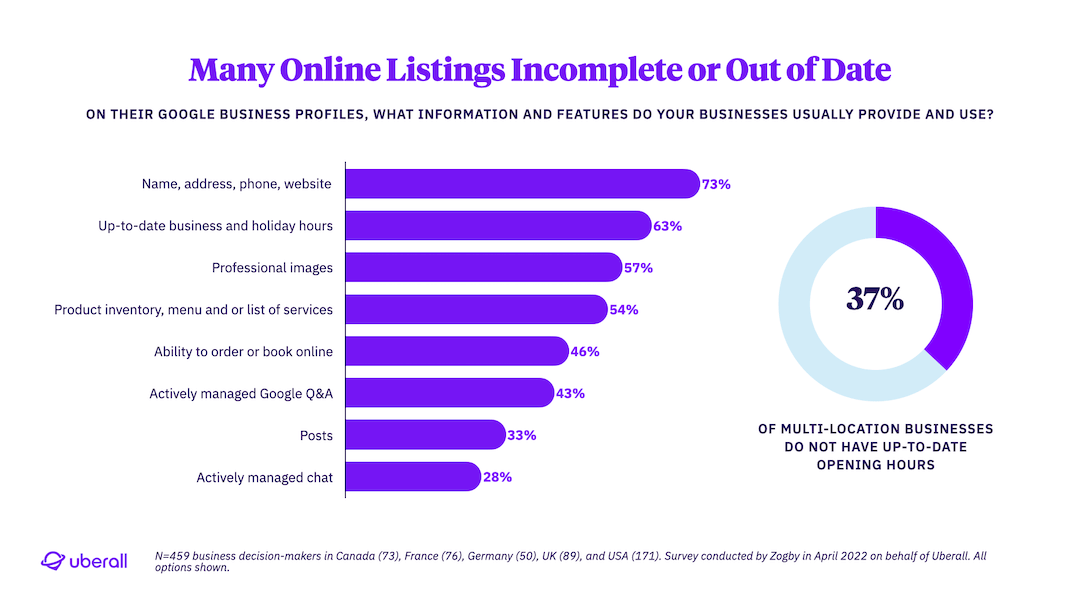
By contrast, a listing with an outdated address, no telephone number for queries, or lacking information on opening hours, dampens the sales argument. In fact, at that very moment, users might decide to look elsewhere, for a provider that actually inspires trust from outset.
Key Challenges for Listings Management at Scale
The core processes involved in keeping listings updated with accurate, consistent data are not especially complicated. The complexity, however, lies in upholding the same high standards for multiple locations, across numerous directories, at all times.
Consider a brand with a modest network of a dozen stores: to begin with, they might decide to maintain listings in a dozen directories. Even this relatively small-scale undertaking adds up to 144 separate listings.
If the owner decides to change the stores’ opening hours, each listing requires manual amendment. This inherently adds to the risk of human error, which could inconvenience customers and impact your search ranking.
The solution lies in a listings management software that prioritizes accuracy, emphasizes efficiency, and includes capacity to accommodate ambitious growth.
Listings Management: Effective Tips and Strategies
One important first step in optimizing your listings management: conduct an audit of the status quo. This way, you can benchmark your performance and measure progress.
You could perform a spot check of listings for a handful of locations, or use specialist auditing tools to gain a more comprehensive picture. Either way, the results can highlight potential issues, such as duplicate listings, allowing you to focus your efforts.
Centralization is also paramount for optimized listings management. In addition to promoting consistency and coherence through a standardized process, centralized management also provides oversight across all of your locations, fostering control and accountability.
Again, high-quality business listings should include accurate, consistent, and up-to-date information at their core. Many maintenance processes for listings involve highly repetitive data entry, making them prime candidates for automation with specialist software.
Finally, you should consider data cleansing services, which systematically review, verify, and update location data for all your locations. This allows you to correct and enrich your listings data, promoting a consistent, quality-oriented footprint across online directories.
Specialist Tools for Optimized Listings Management
Nowadays, you can select from an array of listings management tools, each with different focuses and specialized functionalities. Some offer powerful auditing features, while others target individual directories.
Allow us to introduce our listings management solution, for you to create, manage, and optimize listings across 150+ directories, all from a single, central interface**. Intelligent automations and savvy performance insights enable you to enhance listings, boost online visibility, and drive engagement.
If you’re looking to polish your local listings to curate a seamless customer experience, consider booking a demo to discover the full features of the Uberall platform. And if you’re looking to optimize your tactics, download our report analyzing 115,000 business listings.



1,800 brands trust us to stay visible
— not just show up once or twice in local search.