200 Tasks Across 500 Locations: UB-I Tells You Which Five Matter Most
UB-I is the AI agent that tells multi-location marketers which tasks matter most — ranked by SEO and GEO performance impact, not just urgency.
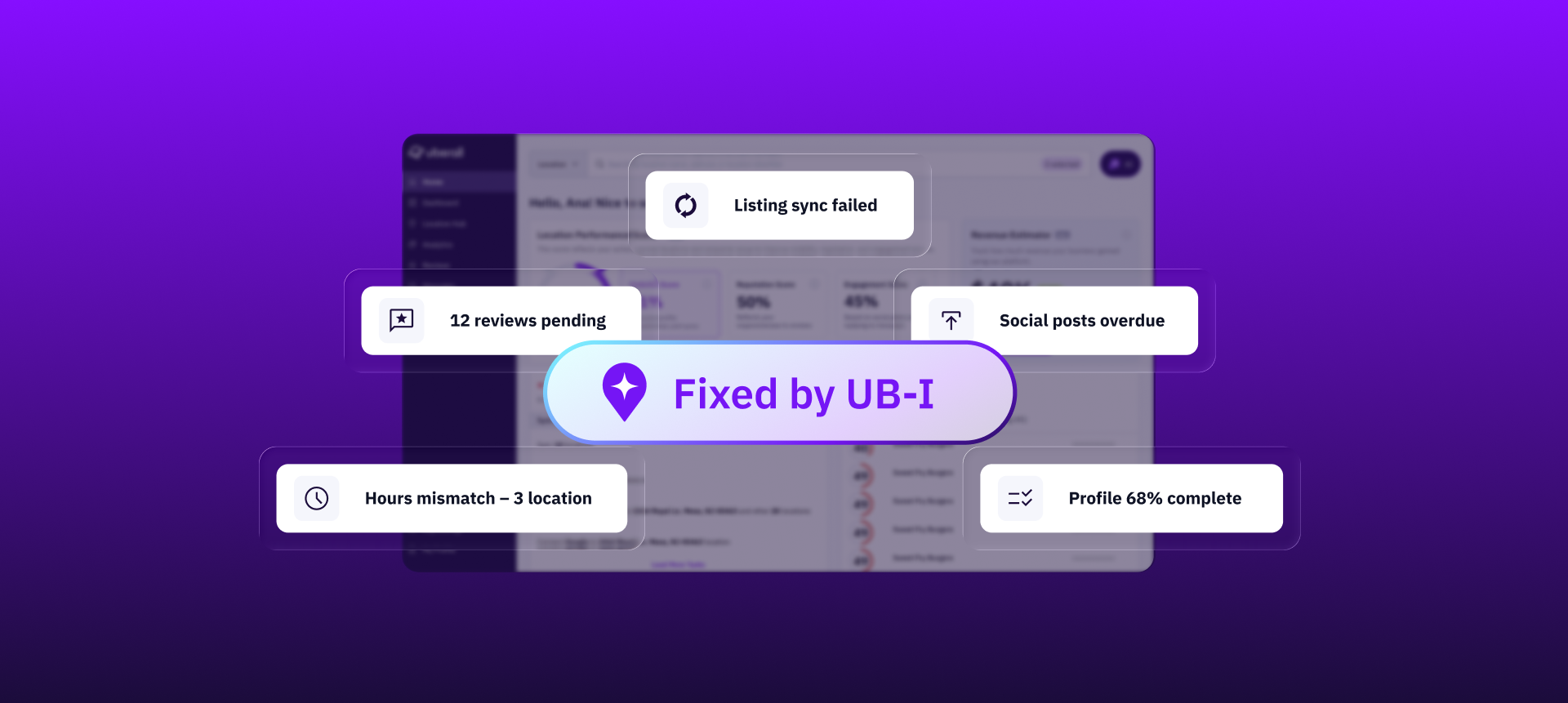

- Multi-location marketers face hundreds of potential tasks each day across listings, reviews, social, and local pages — and most platforms only add more data to the pile instead of telling you where to start
- UB-I is an AI agent built into the Uberall platform that prioritizes every task by its impact on search performance
- Competitors offer competitive intelligence or automation, but neither tells a marketer which of 50 possible actions across 300 locations will move performance impact the most
"With Uberall's LPO framework at its core, UB-I goes beyond saving you time on executing tasks, which is the most you get from other AI agents out there. UB-I's focus on LPO means you're always guided to take specific actions that will impact your business the most, and you can see that impact in your Location Performance Score, and even with our Revenue Estimator."

Our team talks to multi-location marketers almost every week — at events, on calls — and the conversation nearly always lands on the same problem.
A restaurant group with 60+ locations told us they respond to reviews on Yelp, OpenTable, and Google Business Profile individually — on each native platform, one by one.
Listings updates — hours, websites, holiday closures — all manual, all location by location.
Their marketing director summed it up: "We know what we're supposed to be doing. We just don't have a system that tells us what to do first."
I could keep going with examples, but that line really says it all. When you can optimize for everything (and you need to optimize for everything) — where do you start?
And that's an excellent question. Some teams start with what's familiar to build momentum. Others go straight to whatever's the most complex to get that out of the way. But I just haven't come across many teams that operationally start with what moves the needle in location marketing.
When we tell prospects and our customers about UB-I, our AI agent built inside the Uberall platform, there's as much skepticism as curiosity. An AI that scores every task across your locations by how much it moves the meaningful metrics — visibility, reputation, and engagement — so you stop guessing and start acting on what drives revenue? That sounds like exactly what every marketer needs. It also sounds too good to be true.

Tools Show You Red Numbers and Green Numbers, But Not Where to Start
A social media manager at a QSR franchise told us she replies to reviews from her personal phone, letting them build up for a day before batch-responding because she doesn't know which ones matter most.
That "ignorance" is in most cases actually marketing overwhelm, paired with the practicality marketers must adopt to keep up with their workload. Time spent reflecting is time better spent just doing.
It's also the shortcoming of marketing tools today: They show you the state of things rather than the plan of action. They're insightful, yes, but their intuitiveness starts and stops with a dashboard of green and red numbers rather than an explanation of which green and red numbers matter most and how to change them.
A fix and a recommendation aren't the same thing, so why are they often appearing as though they are in dashboards and notifications? While we all appreciate a platform that tells you your competitor outranks you in 12 markets — or that you outrank them, that serves as very poor constructive guidance on where to go from there.
UB-I represents that important 9 AM nudge when marketers log in and know exactly where to start out of the 200 tasks across 500 locations.
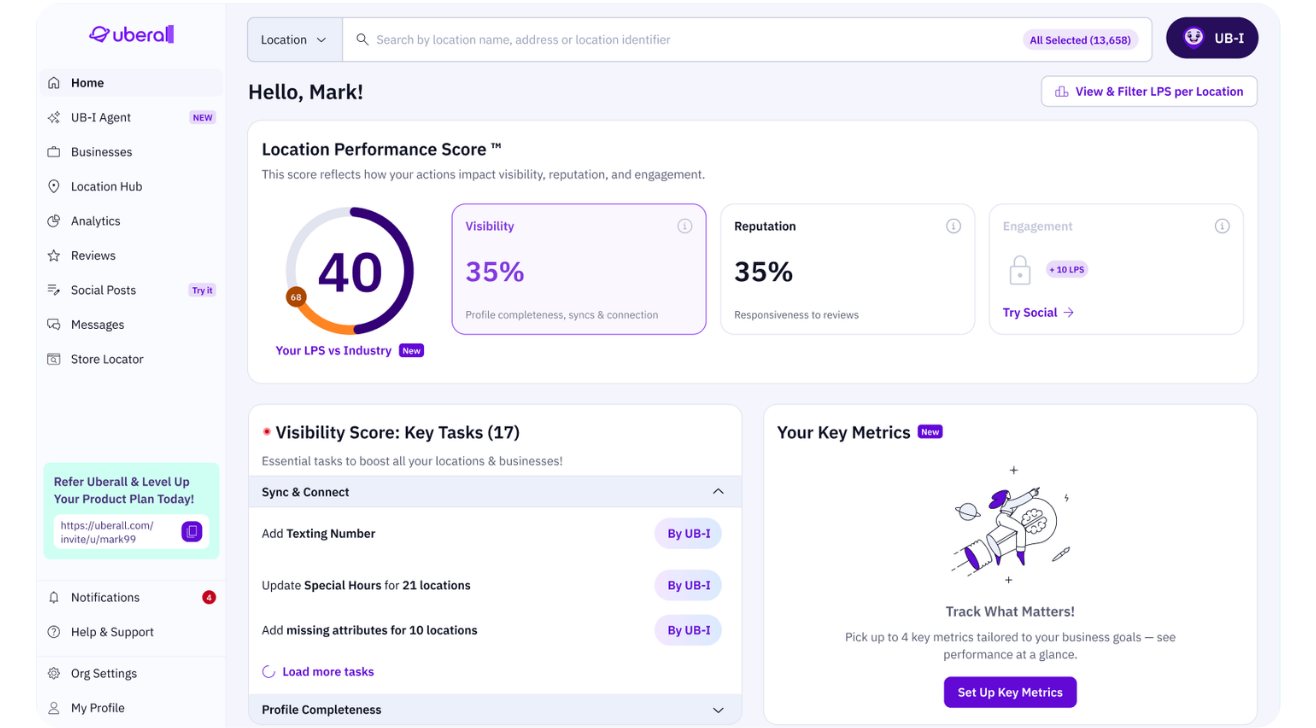
UB-I is built on Uberall's Location Performance Optimization (LPO) model, which means every task it gives you connects to one of three pillars:
- Visibility: are your locations being found?
- Reputation: are your locations trusted?
- Engagement: are users interacting with profiles, the website, social posts, etc.?
These contribute to the fourth pillar: conversion — how these contribute to online and offline actions.
When UB-I tells you to update business descriptions on 12 locations before responding to last week's reviews, it's because the LPO model has determined that those descriptions will do more for your Location Performance Score right now — based on the SEO and GEO ranking factors that drive discoverability for your specific locations. That's what other "agents" on the market aren’t doing.
The Location Performance Score (LPS) is Uberall's in-platform performance metric, based on real-time data, that assesses the overall health and effectiveness of a location's online presence. It's calculated based on key factors like profile completeness, synced listings, resolved reviews, published posts, and answered messages, with each component contributing to a weighted score out of 100.
The downstream logic is simple: Tasks prioritized by search performance impact lead to better visibility, which drives conversion and foot traffic — and ultimately, revenue. Uberall's Revenue Estimator ties this chain together, giving you an estimated view of what your local marketing efforts are worth. It‘s an estimator, not a crystal ball — but it closes the gap between "we did the work" and "here's what it's worth."
{{quote}}
Fix Multi-Location Marketing Tasks by Performance Impact
If you've landed on the home page of the Uberall platform, this is what you'll see: Your tasks, grouped by specific action and ranked by how much they'll influence your visibility, engagement, reputation, and how customers convert on- or offline.
- Reviews, Social, and Listings are separated into tabs, with specific actions
- Inside these tabs, users will see the actions, ranked by impact, such as "Update your opening hours"
- Users can choose to make the change or fix across all locations where that change is needed
Earlier versions of UB-I organized recommendations by location, but for brands managing hundreds or thousands of locations, that meant a lot of scrolling and very little clarity on what to actually prioritize. So UB-I now groups recommendations by action instead.
Each action card is tagged with a priority level — "High impact" or "Low impact" — based on the LPO model and our team's understanding of what most directly impacts local search performance: ranking, AI share of voice, AI citation rate, and more, built from over a decade of data across more than a million locations.
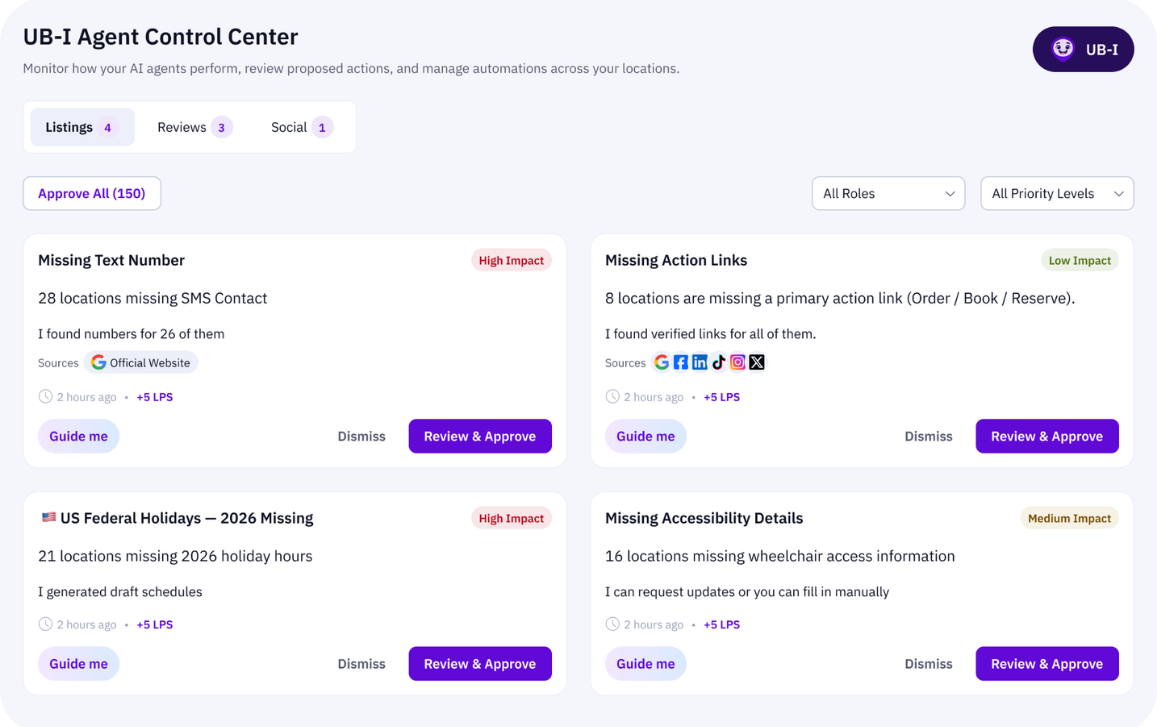
Actions include reviewing AI-drafted replies to negative reviews; name and address formatting corrections across locations that keep getting rejected by sync; or missing attributes and business descriptions for your highest-traffic locations.
Our customers don't just know what they're supposed to be doing – they have a system that tells them what to do first. They arrive at their screens with an inbox of the top scalable, ready-to-approve improvements — multi-location marketing tasks ranked by what matters most, without needing to scroll through them all.
When you complete a task UB-I recommended and drafted, you can see the LPS number increase across your network.
What if you choose not to go with UB-I's prioritization? You're never locked in. You can snooze or dismiss tasks. Over time, UB-I will learn from what you act on. We didn't build the AI agent to override your judgment — we built it to reduce marketing overwhelm and guesswork.
It's difficult to imagine an unproductive working day when you're starting with this kind of momentum. We know how helpful attributing efforts to a score is; on G2, our customers have told us this scoring "helps set a bar" and that they value "the prompts and advice to optimize the score for each location."
Every Completed Task Connects to Performance
Even before UB-I, our customers were telling us the same things about our platform, year after year: easy to use, centralized management, one source of truth. We've been building for simplicity this whole time — after all, that's what multi-location teams actually need. Definitely not more features, but clearer direction and less time spent figuring out where to start.
So we haven't plucked UB-I from thin air and multiple Figma wireframes. UB-I is the most impressive version of that vision yet. It doesn't just show you your location performance; it tells you what you need to do to improve it — and what that's even worth.
Not all of our clients have tried UB-I yet. The only way to change that is to make UB-I so immediately useful that the first time anyone opens it — whether they're an SEO manager, location manager, or franchisee — they don't need convincing it's what they need.
They can see that their workload isn't 200 open tasks across 500 locations anymore; it's three tabs and a place to start building momentum. And they're not trying to do everything — and they're certainly not trying to do everything manually. They're doing the five things that matter most that day, and each one moves a number that matters to the business.



1,800 brands trust us to stay visible
— not just show up once or twice in local search.







Frequently asked questions
AI task prioritization in marketing is when an AI system evaluates every open task — review replies, listing updates, social posts, profile fixes — and ranks them by their expected impact on business performance, not just by deadline or recency. Instead of presenting a flat list of everything that needs doing, it surfaces the actions that will move the metrics most. For multi-location brands, this means replacing guesswork with a data-driven starting point every time a marketer logs in.
Multi-location marketing teams struggle with task overload because the number of tasks scales with every location added — each one has its own listings, reviews, social profiles, and local pages to manage across multiple directories. A brand with 500 locations doesn’t have 500 tasks; it has thousands, and most marketing platforms only add more data to the pile without telling you where to start.
UB-I decides which tasks matter most by scoring every action against the Location Performance Optimization (LPO) model — a framework built on three pillars: visibility (are your locations being found?), reputation (are they trusted?), and engagement (are users interacting?). These feed into the fourth pillar, conversion. When UB-I tells you to update business descriptions before responding to last week’s reviews, it’s because the LPO model determined those descriptions will do more for your search performance right now.
Urgency-based prioritization ranks tasks by recency or deadline — the newest review, the most overdue listing update, whatever’s flashing red on the dashboard. Impact-based prioritization ranks tasks by how much they’ll move the metrics that matter to the business, like search visibility, AI discoverability, and revenue. The difference is practical: Urgency-based systems tell you what’s late, while impact-based systems tell you what’s worth doing first. Most marketing dashboards default to urgency; UB-I defaults to impact.
Marketing tasks in UB-I are grouped by action type — reviews, social, and listings — not by location. Earlier versions organized recommendations by location, but for brands managing hundreds or thousands of locations, that meant too much scrolling and too little clarity. Now each tab shows specific actions ranked by impact, like "update your opening hours" or "review AI-drafted replies to negative reviews." Users can review and apply the fix across all affected locations at once from a single action card.
Location Performance Optimization (LPO) is an operating model that connects local marketing efforts directly to revenue by unifying visibility, reputation, engagement, and conversion into one measurable framework. UB-I uses LPO as its decision engine: Every task it recommends or performs is scored against these four pillars so the highest-impact action comes first. This means UB-I doesn’t just complete tasks; it completes the tasks most likely to drive revenue at each location.
Yes, platform users are never locked into UB-I’s recommendations. Each recommendation can be approved, edited, snoozed, or dismissed. Over time, UB-I learns from what you act on and what you skip, so its suggestions get sharper the more your team uses it. The system was built to reduce marketing overwhelm and guesswork, not to override your judgment.
AI task prioritization connects marketing effort to revenue through a direct chain: Tasks prioritized by search performance impact lead to better visibility, which drives conversion and foot traffic.